A parent function is the simplest function of a family that preserves the shape of the graph and serves as a base for transformations.
Describe the parent function of a linear function.
The parent function of a linear function is \(f(x) = x\), which graphs as a straight line through the origin with slope 1.
What is the parent function of a quadratic function?
The parent function of a quadratic function is \(f(x) = x^2\), which graphs as a parabola opening upward with vertex at the origin.
Identify the parent function of a cubic function.
The parent function of a cubic function is \(f(x) = x^3\), which has an S-shaped curve passing through the origin.
What is the parent function of the absolute value function?
The parent function of the absolute value function is \(f(x) = |x|\), which forms a V-shaped graph with vertex at the origin.
Describe the parent function of the square root function.
The parent function of the square root function is \(f(x) = \sqrt{x}\), which starts at the origin and increases slowly to the right.
What is the parent function of the exponential function?
The parent function of the exponential function is \(f(x) = b^x\) where b is a positive constant not equal to 1, typically e or 2.
Identify the parent function of the logarithmic function.
The parent function of the logarithmic function is \(f(x) = \log_b x\), the inverse of the exponential function.
What is the parent function of the reciprocal function?
The parent function of the reciprocal function is \(f(x) = \frac{1}{x}\), which has two branches in quadrants I and III with vertical and horizontal asymptotes.
How do transformations affect parent functions?
Transformations such as shifts, stretches, compressions, and reflections modify the graph of a parent function without changing its basic shape.
What is the general effect of adding a constant to a parent function?
Adding a constant k to a function \(f(x)\) results in a vertical shift: \(f(x) + k\) shifts the graph up if k is positive, down if negative.
What does multiplying a parent function by a negative number do?
Multiplying by a negative number reflects the graph across the x-axis, flipping it upside down.
Explain the effect of horizontal shifts on parent functions.
Replacing \(x\) with \(x - h\) shifts the graph horizontally: right if h is positive, left if negative.
What is the parent function of the constant function?
The parent function of the constant function is \(f(x) = c\), where c is a constant, graphing as a horizontal line.
How is the identity function related to parent functions?
The identity function \(f(x) = x\) is the parent function for all linear functions with slope 1 and no intercept.
What is the domain of the square root parent function?
The domain of \(f(x) = \sqrt{x}\) is \([0, \infty)\) because the square root of negative numbers is not real.
What are the asymptotes of the reciprocal parent function?
The reciprocal function \(f(x) = \frac{1}{x}\) has a vertical asymptote at \(x=0\) and a horizontal asymptote at \(y=0\).
What is the range of the absolute value parent function?
The range of \(f(x) = |x|\) is \([0, \infty)\) since absolute values are never negative.
How does the cubic parent function behave as x approaches infinity?
As \(x \to \infty\), \(f(x) = x^3\) approaches infinity; as \(x \to -\infty\), it approaches negative infinity.
What is the significance of parent functions in graphing?
Parent functions provide a foundation to understand and graph more complex functions through transformations.
 Indietro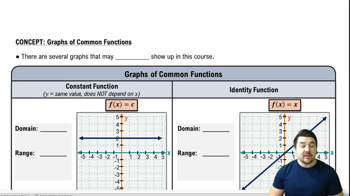
 5:57
5:57