Skip to main content
Precalculus
Il mio corso
Impara
Preparazione agli esami
AI Tutor
Guide di studio
Flashcard
Esplora
Prova l'app
Il mio corso
Impara
Preparazione agli esami
AI Tutor
Guide di studio
Flashcard
Esplora
Prova l'app
Indietro
Precalculus: Polynomial Functions
Puoi toccare per girare la carta.
What defines a polynomial function?
Puoi toccare per girare la carta.
👆
What defines a polynomial function?
A polynomial function is defined as \(f(x) = a_nx^n + a_{n-1}x^{n-1} + \cdots + a_1x + a_0\) where n is a nonnegative integer and
a_n \(\neq\) 0
.
Avanzamenti del tracciato
I pulsanti di controllo sono stati cambiati in modalità "navigazione".
1/20
Video consigliati
03:34
Adding and Subtracting Polynomials
1590
views
56
rank
05:16
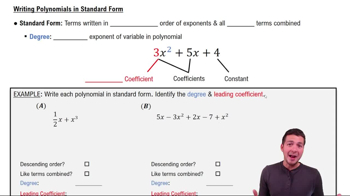
Standard Form of Polynomials
1779
views
73
rank
05:13
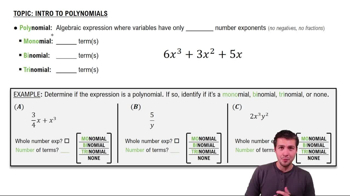
Introduction to Polynomials
2513
views
101
rank
2
comments
Termini in questo insieme (20)
Nascondere definizioni
What defines a polynomial function?
A polynomial function is defined as \(f(x) = a_nx^n + a_{n-1}x^{n-1} + \cdots + a_1x + a_0\) where n is a nonnegative integer and
a_n \(\neq\) 0
.
What is the degree of a polynomial?
The degree of a polynomial is the highest power of the variable with a nonzero coefficient.
Is \(f(x) = x + 3\) a polynomial? If yes, what is its degree?
Yes, it is a polynomial of degree 1.
Is \(g(x) = 7x^5 - \pi x^3 + \frac{1}{5}x\) a polynomial? If yes, what is its degree?
Yes, it is a polynomial of degree 5.
Is \(h(x) = 8x^3 - x^2 + \frac{2}{x}\) a polynomial? Why or why not?
No, because it contains a term with
x
in the denominator, which is not allowed in polynomials.
What is the end behavior of a polynomial with odd degree and positive leading coefficient?
The graph falls to the left and rises to the right.
What is the end behavior of a polynomial with odd degree and negative leading coefficient?
The graph rises to the left and falls to the right.
What is the end behavior of a polynomial with even degree and positive leading coefficient?
The graph rises to the left and rises to the right.
What is the end behavior of a polynomial with even degree and negative leading coefficient?
The graph falls to the left and falls to the right.
How do you find the roots of a polynomial?
Set the polynomial equal to zero and solve by factoring or using the quadratic formula.
What does the multiplicity of a root tell you about the graph at that root?
If the root has even multiplicity, the graph touches and turns around at the x-axis. If odd multiplicity, the graph crosses the x-axis.
What is the maximum number of turning points for a polynomial of degree n?
At most \(n - 1\) turning points.
How does the graph behave near a root with multiplicity greater than 1?
The graph flattens out near the root.
What is the y-intercept of a polynomial function?
The y-intercept is the value of the polynomial at \(x=0\), i.e., \(f(0)\).
How can symmetry help in graphing polynomials?
If \(f(-x) = f(x)\), the graph is symmetric about the y-axis. If \(f(-x) = -f(x)\), the graph is symmetric about the origin.
Is the function \(f(x) = x^2\) even, odd, or neither?
It is even because \(f(-x) = f(x)\).
Is the function \(f(x) = x^3 + 4x^2\) even, odd, or neither?
It is neither even nor odd.
What happens to the graph at a root with multiplicity 2?
The graph touches the x-axis and bounces off (turns around) at that root.
What happens to the graph at a root with multiplicity 3?
The graph crosses the x-axis and flattens near that root.
How do you determine if a function is a polynomial from its formula?
Check if all exponents of
x
are whole numbers and no variables appear in denominators or under roots.
 IndietroIndietro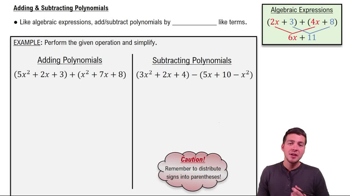
 03:34
03:34