Skip to main content
Precalculus
Il mio corso
Impara
Preparazione agli esami
AI Tutor
Guide di studio
Flashcard
Esplora
Prova l'app
Il mio corso
Impara
Preparazione agli esami
AI Tutor
Guide di studio
Flashcard
Esplora
Prova l'app
Indietro
Precalculus Polynomial Review
Puoi toccare per girare la carta.
Degree of polynomial p(x) = 5x(x+2)^3(x-1)
Puoi toccare per girare la carta.
👆
Degree of polynomial p(x) = 5x(x+2)^3(x-1)
The degree is \(5\) (1 + 3 + 1).
Avanzamenti del tracciato
I pulsanti di controllo sono stati cambiati in modalità "navigazione".
1/22
Video consigliati
03:34
Adding and Subtracting Polynomials
1596
views
56
rank
05:16
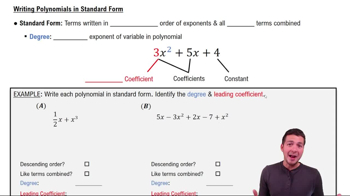
Standard Form of Polynomials
1785
views
73
rank
05:13
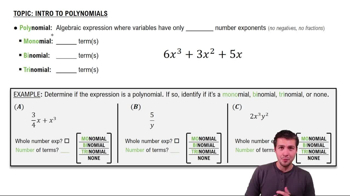
Introduction to Polynomials
2521
views
102
rank
2
comments
Termini in questo insieme (22)
Nascondere definizioni
Degree of polynomial p(x) = 5x(x+2)^3(x-1)
The degree is \(5\) (1 + 3 + 1).
End behavior of g(x) = -2x^4 + 3x^2 - 4x + 10
As x → ±∞, g(x) → -∞ because leading term is negative and degree is even.
X-intercepts of h(x) = x(x-1)^2(x+5)^3
Zeros at x = 0, 1, and -5.
Other zero if polynomial has real zero at 2 and complex zero at 3 + 2i
The other zero is 3 - 2i (complex zeros come in conjugate pairs).
Maximum number of real zeros for degree 8 polynomial
Maximum of 8 real zeros.
Simplify (2 + 3i)(2 - 3i)
Equals 13 (difference of squares: 2^2 - (3i)^2 = 4 + 9).
Simplify i^6
Equals -1 (since i^4 = 1, i^6 = i^4 * i^2 = 1 * -1).
Degree of p(x) = 2x(x+2)^3(x-1)^2
Degree is 6 (1 + 3 + 2).
End behavior of p(x) = 2x(x+2)^3(x-1)^2
As x → ∞, p(x) → ∞; as x → -∞, p(x) → -∞ (leading coefficient positive, degree even).
Zeros, multiplicities, and behavior of p(x) = 2x(x+2)^3(x-1)^2
Zero at 0 (mult 1, crosses), -2 (mult 3, wiggles), 1 (mult 2, bounces).
Maximum number of turning points for degree 6 polynomial
Maximum turning points is 5 (degree - 1).
Y-intercept of p(x) = 2x(x+2)^3(x-1)^2
Evaluate p(0) = 2*0*(2)^3*(-1)^2 = 0.
Form polynomial with zeros 2, 1, -1 and leading coefficient 1
Polynomial is (x-2)(x-1)(x+1) = x^3 - 2x^2 - x + 2.
Is x-2 a factor of p(x) = x^3 - 2x^2 + 3x - 6?
Use Remainder Theorem: p(2) = 0, so yes, x-2 is a factor.
Domain of f(x) = -2x^3 + 5x^2 - 3x + 1
Domain is all real numbers.
Maximum number of real zeros for cubic polynomial
Maximum of 3 real zeros.
Y-intercept of f(x) = -2x^3 + 5x^2 - 3x + 1
Y-intercept is f(0) = 1.
Possible rational zeros of p(x) = x^3 + 4x^2 + x - 6
Possible zeros are ±1, ±2, ±3, ±6.
Use Rational Zero Theorem to find zeros of p(x) = x^3 + 4x^2 + x - 6
Test possible zeros to find real zeros, then factor polynomial.
Identify polynomial or not: f(x) = 3x^3 + 4x^2 - 1/x
Not a polynomial (has variable in denominator).
Identify polynomial or not: g(x) = -200x^4 + 59x^3 - 23
Polynomial (all terms have non-negative integer exponents).
Identify polynomial or not: q(x) = 3x^2 + 4x - √x
Not a polynomial (√x = x^(1/2) is not an integer exponent).
 IndietroIndietro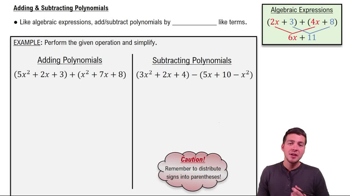
 03:34
03:34