Skip to main content
Precalculus
Il mio corso
Impara
Preparazione agli esami
AI Tutor
Guide di studio
Flashcard
Esplora
Prova l'app
Il mio corso
Impara
Preparazione agli esami
AI Tutor
Guide di studio
Flashcard
Esplora
Prova l'app
Indietro
Precalculus: Quadratics, Polynomials, and Complex Numbers
Puoi toccare per girare la carta.
Quadratic formula
Puoi toccare per girare la carta.
👆
Quadratic formula
The formula to find roots of ax² + bx + c = 0 is \(x=\frac{-b\pm\sqrt{b^2-4ac}}{2a}\).
Avanzamenti del tracciato
I pulsanti di controllo sono stati cambiati in modalità "navigazione".
1/21
Video consigliati
04:36
Factor by Grouping
1874
views
40
rank
07:30
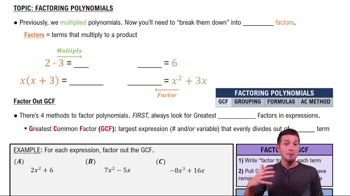
Introduction to Factoring Polynomials
3234
views
88
rank
6:29
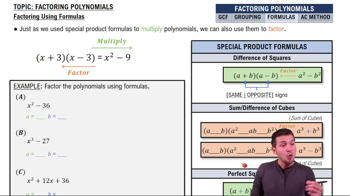
Factor Using Special Product Formulas
1621
views
33
rank
Termini in questo insieme (21)
Nascondere definizioni
Quadratic formula
The formula to find roots of ax² + bx + c = 0 is \(x=\frac{-b\pm\sqrt{b^2-4ac}}{2a}\).
Discriminant in quadratic formula
The expression \(b^2-4ac\) determines the nature of roots: positive means two real roots, zero means one real root, negative means two complex roots.
Factoring a trinomial
Express a quadratic \(ax^2+bx+c\) as a product of two binomials, e.g., \((mx+n)(px+q)\).
Steps to factor a trinomial
Find two numbers that multiply to \(ac\) and add to \(b\), then split the middle term and factor by grouping.
Factoring polynomials
Break down a polynomial into products of simpler polynomials, often starting with factoring out the greatest common factor.
Greatest common factor (GCF)
The largest expression that divides all terms of a polynomial without remainder.
Multiplying complex numbers
Use distributive property and apply \(i^2 = -1\) to simplify products of complex numbers.
Standard form of a complex number
A complex number is written as \(a+bi\), where \(a\) and \(b\) are real numbers.
Factoring difference of squares
Use the formula \(a^2 - b^2 = (a-b)(a+b)\) to factor expressions.
Finding solution sets of quadratic equations
Solutions can be found by factoring, using the quadratic formula, or completing the square.
Completing the square
Rewrite \(ax^2 + bx + c\) as a perfect square trinomial plus a constant to solve quadratics.
Multiplying binomials
Use FOIL method: multiply First, Outer, Inner, Last terms and combine like terms.
Sum and product of roots
For \(ax^2 + bx + c = 0\), sum of roots is \(-\frac{b}{a}\) and product is \(\frac{c}{a}\).
Polynomial degree
The highest power of the variable in the polynomial.
Leading coefficient
The coefficient of the term with the highest degree in a polynomial.
Zero product property
If \(ab=0\), then either \(a=0\) or \(b=0\).
Conjugate of a complex number
For \(a+bi\), the conjugate is \(a - bi\).
Multiplying complex conjugates
The product of conjugates \((a+bi)(a-bi)\) equals \(a^2 + b^2\).
Factoring by grouping
Group terms in pairs and factor out common factors to simplify polynomials.
Sum of cubes factoring formula
Use \(a^3 + b^3 = (a+b)(a^2 - ab + b^2)\).
Difference of cubes factoring formula
Use \(a^3 - b^3 = (a-b)(a^2 + ab + b^2)\).
 IndietroIndietro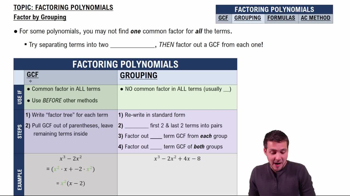
 04:36
04:36