Skip to main content
Precalculus
Il mio corso
Impara
Preparazione agli esami
AI Tutor
Guide di studio
Flashcard
Esplora
Prova l'app
Il mio corso
Impara
Preparazione agli esami
AI Tutor
Guide di studio
Flashcard
Esplora
Prova l'app
Indietro
Precalculus: Radicals and Rational Exponents
Puoi toccare per girare la carta.
Principal square root of a squared
Puoi toccare per girare la carta.
👆
Principal square root of a squared
For any real number a, the principal square root of \(a^2\) is the absolute value of a.
Avanzamenti del tracciato
I pulsanti di controllo sono stati cambiati in modalità "navigazione".
1/20
Video consigliati
05:49
Square Roots
1911
views
40
rank
06:56
Nth Roots
1240
views
50
rank
1
comments
Termini in questo insieme (20)
Nascondere definizioni
Principal square root of a squared
For any real number a, the principal square root of \(a^2\) is the absolute value of a.
Product rule for square roots
If a and b are nonnegative real numbers, then \(\sqrt{a} \cdot \sqrt{b} = \sqrt{ab}\).
Quotient rule for square roots
If a and b are nonnegative real numbers and b ≠ 0, then \(\frac{\sqrt{a}}{\sqrt{b}} = \sqrt{\frac{a}{b}}\).
Like radicals
Radicals that have the same radicand and index, which can be added or subtracted using the distributive property.
Rationalizing the denominator
Rewriting a radical expression so the denominator contains no radicals by multiplying numerator and denominator by a suitable radical or conjugate.
Conjugates
Expressions of the form \(a + \sqrt{b}\) and \(a - \sqrt{b}\); used to rationalize denominators with two terms.
Principal nth root of a real number
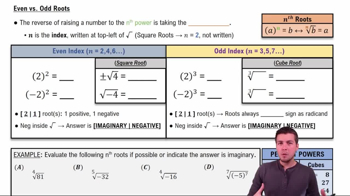
For \(\sqrt[n]{a} = b\), if n is even, a and b are nonnegative; if n is odd, a and b can be any real numbers.
Radical and radicand
The symbol \(\sqrt[n]{}\) is called a radical, and the expression under it is the radicand.
Finding nth roots of perfect nth powers (odd n)
If n is odd, \(\sqrt[n]{a^n} = a\) for any real number a.
Finding nth roots of perfect nth powers (even n)
If n is even, \(\sqrt[n]{a^n} = |a|\) where a is real.
Product rule for nth roots
For real numbers a and b, \(\sqrt[n]{a} \cdot \sqrt[n]{b} = \sqrt[n]{ab}\).
Quotient rule for nth roots
For real numbers a and b with b ≠ 0, \(\frac{\sqrt[n]{a}}{\sqrt[n]{b}} = \sqrt[n]{\frac{a}{b}}\).
Definition of
a
to the power of 1/n
For real number a and positive integer n, \(a^{\frac{1}{n}} = \sqrt[n]{a}\).
Definition of
a
to the power of m/n
For real number a, positive integer n, and integer m, \(a^{\frac{m}{n}} = \left(\sqrt[n]{a}\right)^m = \sqrt[n]{a^m}\).
Properties of rational exponents
Rational exponents follow exponent rules: \(a^{m/n} \cdot a^{p/q} = a^{m/n + p/q}\) and \((a^{m/n})^{p/q} = a^{(m/n)(p/q)}\).
Simplifying expressions with rational exponents
Use the definition of rational exponents and properties of exponents to rewrite and simplify expressions.
Adding and subtracting square roots
Only like radicals (same radicand and index) can be added or subtracted by combining coefficients.
Rationalizing denominators with conjugates
Multiply numerator and denominator by the conjugate of the denominator to eliminate radicals in denominators with two terms.
Simplifying square roots using product rule example
Example: \(\sqrt{50} = \sqrt{25 \cdot 2} = 5\sqrt{2}\).
Simplifying square roots using quotient rule example
Example: \(\frac{\sqrt{18}}{\sqrt{2}} = \sqrt{\frac{18}{2}} = \sqrt{9} = 3\).
 IndietroIndietro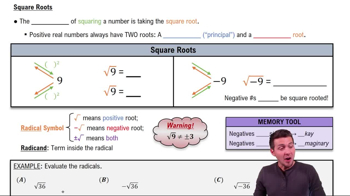
 05:49
05:49