 Indietro
Precalculus: Slope of a Line
 05:39
05:39
Termini in questo insieme (20)
The slope of a line measures its steepness and is the ratio of the vertical change to the horizontal change between two points.
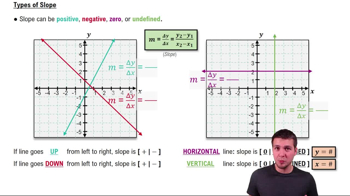
Slope m is calculated as \(m = \frac{y_2 - y_1}{x_2 - x_1}\).
A positive slope means the line rises from left to right.
A negative slope means the line falls from left to right.
The slope of a horizontal line is \(0\).
The slope of a vertical line is undefined.
The slope represents the rate of change between two variables.
A slope of zero means there is no change in the dependent variable as the independent variable changes.
Choose two points on the line and use \(m = \frac{\text{rise}}{\text{run}}\).
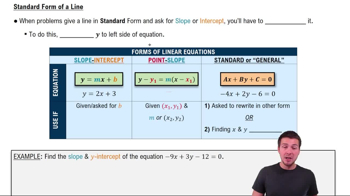
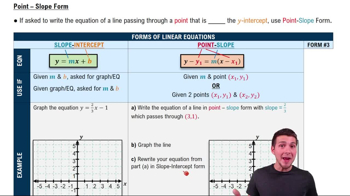
In \(y = mx + b\), the coefficient m is the slope.
The slope is the tangent of the angle the line makes with the positive x-axis.
Calculate the change in y-values divided by the change in x-values between two points.
Slope \(m = \frac{13 - 7}{6 - 3} = \frac{6}{3} = 2\).
The line is vertical and does not run left to right.
Parallel lines have equal slopes.
Perpendicular lines have slopes that are negative reciprocals of each other.
Rewrite as \(y = -\frac{2}{3}x + 2\), so slope is \(-\frac{2}{3}\).
Slope helps understand rates of change and is foundational for functions and calculus concepts.
For every 2 units increase in x, y increases by 1 unit.
Slope is \(0\) because the line is horizontal.