 Indietro
Precalculus: Trigonometric Functions and Applications
 5:50
5:50
Termini in questo insieme (19)
sin A = opposite/hypotenuse, cos A = adjacent/hypotenuse, tan A = opposite/adjacent
Opposite side = 7, Adjacent side = 24, Hypotenuse = 25
30°: sin = 1/2, cos = \(\frac{\sqrt{3}}{2}\), tan = \(\frac{1}{\sqrt{3}}\)
45°: sin = cos = \(\frac{\sqrt{2}}{2}\), tan = 1
60°: sin = \(\frac{\sqrt{3}}{2}\), cos = 1/2, tan = \(\sqrt{3}\)
sin A = cos (90° - A) and cos A = sin (90° - A)
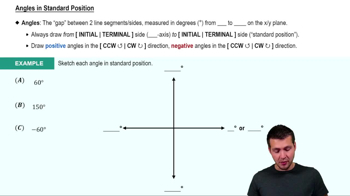
A reference angle is the acute angle between the terminal side of an angle and the x-axis.
Subtract the nearest x-axis angle (0°, 180°, or 360°) to get an acute angle between 0° and 90°.
218° - 180° = 38°
1387° - 3 × 360° = 307°, then 360° - 307° = 53°
Reference angle is 30°. Use 30° trig values and adjust sign based on quadrant III.
- Find coterminal angle between 0° and 360°
- Find reference angle
- Find trig values for reference angle
- Adjust signs based on quadrant
–240° coterminal with 120°, reference angle 60°, cos negative in quadrant II, so cos(–240°) is negative.
675° coterminal with 315°, reference angle 45°, tan negative in quadrant IV, so tan 675° = –1.
Sine is positive, cosine is negative in quadrant II.
Both sine and cosine are negative in quadrant III.
Set calculator to degree or radian mode and use sin, cos, tan, or their inverses to find approximate values.
θ ≈ sin⁻¹(0.9677) = 75.4°
θ ≈ tan⁻¹(0.25) = 0.24498 radians
θ = 135° (quadrant II) and 225° (quadrant III)
First θ ≈ 1.2 radians (quadrant I), second θ ≈ 2π – 1.2 ≈ 5.08 radians (quadrant IV)