Skip to main content
Introduction to Psychology
Il mio corso
Impara
Preparazione agli esami
AI Tutor
Guide di studio
Flashcard
Esplora
Prova l'app
Il mio corso
Impara
Preparazione agli esami
AI Tutor
Guide di studio
Flashcard
Esplora
Prova l'app
Indietro
Classical Conditioning definitions
Puoi toccare per girare la carta.
Classical Conditioning
Puoi toccare per girare la carta.
👆
Classical Conditioning
A learning process where a neutral stimulus acquires the ability to elicit a response after being paired with an unconditioned stimulus.
Avanzamenti del tracciato
I pulsanti di controllo sono stati cambiati in modalità "navigazione".
1/15
Flashcard correlate
Pratica correlata
Video consigliati
Classical Conditioning quiz #1
Classical Conditioning
40 Termini
Classical Conditioning quiz #2
Classical Conditioning
40 Termini
Classical Conditioning quiz #3
Classical Conditioning
40 Termini
Classical Conditioning
6. Learning
7 Problemi
Argomento
Nicole
Applications of Classical Conditioning
6. Learning
7 Problemi
Argomento
Nicole
6. Learning
4 Argomenti
10 Problemi
Capitolo
Nicole
VideoThumbView.guidedCourse
06:45
Principles of Classical Conditioning
1332
views
22
rank
VideoThumbView.guidedCourse
01:32
Classical Conditioning Example 4
729
views
8
rank
VideoThumbView.guidedCourse
01:29
Classical Conditioning Example 5
692
views
6
rank
Termini in questo insieme (15)
Nascondere definizioni
Classical Conditioning
A learning process where a neutral stimulus acquires the ability to elicit a response after being paired with an unconditioned stimulus.
Ivan Pavlov
Russian physiologist who discovered the principles of classical conditioning through experiments with dogs and digestion.
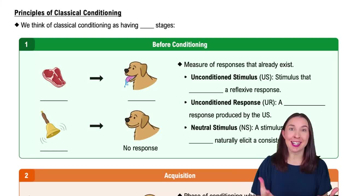
Unconditioned Stimulus
A trigger that naturally and automatically evokes a reflexive response without prior learning.
Unconditioned Response
A reflexive, automatic reaction to a stimulus that occurs without previous training or learning.
Neutral Stimulus
An input that initially produces no specific or consistent reaction before conditioning occurs.
Conditioned Stimulus
A previously neutral input that, after association, reliably triggers a learned reaction.
Conditioned Response
A learned reaction that is triggered by a conditioned stimulus, often mirroring the unconditioned response.
Acquisition
The phase during which a neutral stimulus is repeatedly paired with an unconditioned stimulus, leading to learning.
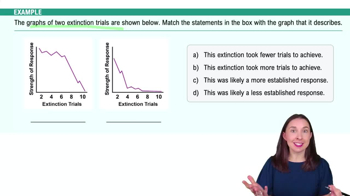
Extinction
The process where a learned reaction fades when the conditioned stimulus is presented without the unconditioned stimulus.
Second-Order Conditioning
A process where a new neutral stimulus becomes a conditioned stimulus by association with an existing conditioned stimulus.
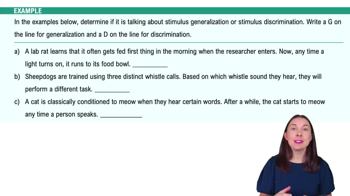
Stimulus Generalization
The tendency for stimuli similar to the conditioned stimulus to evoke the conditioned response.
Stimulus Discrimination
The learned ability to distinguish between the conditioned stimulus and other similar but irrelevant stimuli.
Spontaneous Recovery
The sudden reappearance of a previously extinguished conditioned response after a rest period.
Biological Preparedness
An organism's innate tendency to form certain associations more easily due to evolutionary advantages.
Associative Learning
A broad category of learning involving connections between environmental stimuli and behavioral responses.
 IndietroIndietro
 06:45
06:45