Skip to main content
Introduction to Psychology
Il mio corso
Impara
Preparazione agli esami
AI Tutor
Guide di studio
Flashcard
Esplora
Prova l'app
Il mio corso
Impara
Preparazione agli esami
AI Tutor
Guide di studio
Flashcard
Esplora
Prova l'app
Indietro
Information Processing Model definitions
Puoi toccare per girare la carta.
Information Processing Model
Puoi toccare per girare la carta.
👆
Information Processing Model
A framework comparing human memory to computer operations, emphasizing sequential stages of handling information.
Avanzamenti del tracciato
I pulsanti di controllo sono stati cambiati in modalità "navigazione".
1/14
Flashcard correlate
Pratica correlata
Video consigliati
Information Processing Model quiz #1
Information Processing Model
22 Termini
Information Processing Model
7. Memory
7 Problemi
Argomento
Nicole
Storage - The Three Box Model of Memory
7. Memory
7 Problemi
Argomento
Nicole
7. Memory
2 Argomenti
5 Problemi
Capitolo
Nicole
VideoThumbView.guidedCourse
01:41
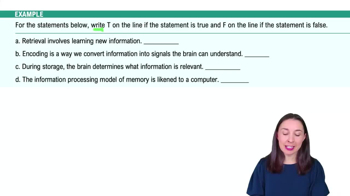
Information Processing Model Example 1
980
views
11
rank
VideoThumbView.guidedCourse
01:49
Information Processing Model
1430
views
29
rank
Termini in questo insieme (14)
Nascondere definizioni
Information Processing Model
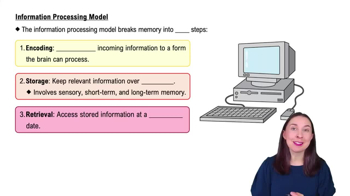
A framework comparing human memory to computer operations, emphasizing sequential stages of handling information.
Encoding
The transformation of sensory input into neural signals, allowing the brain to interpret and process data.
Storage
The maintenance of information over time within distinct memory systems, ensuring data is preserved for future use.
Retrieval
The process of accessing previously stored information, enabling recall and use of memories when needed.
Sensory Memory
A brief initial stage that holds incoming sensory information for a fraction of a second before further processing.
Short-Term Memory
A temporary storage system that retains limited information for a short duration, crucial for immediate tasks.
Long-Term Memory
A durable storage system capable of holding vast amounts of information for extended periods, supporting lasting recall.
Hippocampus
A brain structure essential for consolidating new memories, facilitating the transfer from short-term to long-term storage.
Consolidation
The process by which short-term memories are stabilized and integrated into long-term storage, enhancing retention.
Sensory Register
A component that briefly captures raw sensory data, acting as the gateway for information entering the memory system.
Working Memory
An active system for manipulating and managing information held temporarily, supporting reasoning and comprehension.
Long-Term Potentiation
A neural mechanism that strengthens synaptic connections, underlying the formation and retention of long-term memories.
Recall
The act of retrieving information from memory without external cues, demonstrating the effectiveness of retrieval processes.
Cognitive Processes
Mental activities involved in acquiring, storing, and using knowledge, fundamental to understanding memory and learning.
 IndietroIndietro
 01:41
01:41