Skip to main content
Introduction to Psychology
Il mio corso
Impara
Preparazione agli esami
AI Tutor
Guide di studio
Flashcard
Esplora
Prova l'app
Il mio corso
Impara
Preparazione agli esami
AI Tutor
Guide di studio
Flashcard
Esplora
Prova l'app
Indietro
Perspectives on Psychological Disorders definitions
Puoi toccare per girare la carta.
Diathesis
Puoi toccare per girare la carta.
👆
Diathesis
An internal vulnerability, such as genetic predisposition or cognitive bias, increasing susceptibility to psychological disorders.
Avanzamenti del tracciato
I pulsanti di controllo sono stati cambiati in modalità "navigazione".
1/15
Flashcard correlate
Pratica correlata
Video consigliati
Perspectives on Psychological Disorders quiz #1
Perspectives on Psychological Disorders
10 Termini
Perspectives on Psychological Disorders
14. Psychological Disorders
7 Problemi
Argomento
Nicole
Prevalence and Comorbidity
14. Psychological Disorders
7 Problemi
Argomento
14. Psychological Disorders
5 Argomenti
11 Problemi
Capitolo
Nicole
VideoThumbView.guidedCourse
05:09
Diathesis-Stress Model
488
views
2
rank
VideoThumbView.guidedCourse
04:09
The Biopsychosocial Model
428
views
4
rank
VideoThumbView.guidedCourse
02:42
Example 1
344
views
1
rank
Termini in questo insieme (15)
Nascondere definizioni
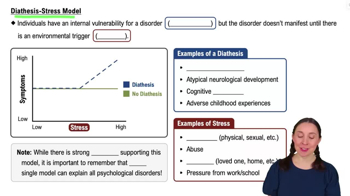
Diathesis
An internal vulnerability, such as genetic predisposition or cognitive bias, increasing susceptibility to psychological disorders.
Stress
An environmental trigger, like trauma or loss, that interacts with internal vulnerabilities to influence disorder development.
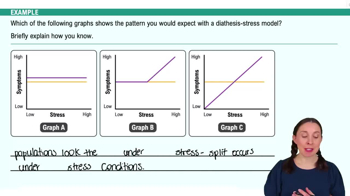
Diathesis-Stress Model
A framework explaining disorders as emerging from the interaction between internal vulnerabilities and external stressors.
Genetic Predisposition
An inherited tendency that raises the likelihood of developing certain psychological disorders.
Cognitive Bias
A mental tendency to focus on negative events or ruminate, contributing to vulnerability for disorders.
Adverse Childhood Experiences
Early life events, such as abuse or neglect, that increase risk for later psychological difficulties.
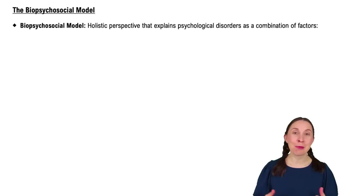
Biopsychosocial Model
A holistic approach integrating biological, psychological, and social factors to explain psychological disorders.
Biological Factors
Physical or genetic influences, such as hormone levels or brain development, affecting mental health.
Psychological Factors
Internal processes like cognition, emotion, and memory that shape vulnerability to disorders.
Social Factors
Environmental and cultural influences, including stressors and support systems, impacting mental health.
Pharmacological Therapy
Treatment involving medication to address biological aspects of psychological disorders.
Cognitive Behavioral Therapy
A structured intervention targeting thought patterns to reduce symptoms of psychological disorders.
Community Support
Assistance from social groups or networks, such as grief groups, aiding recovery from psychological distress.
Symptom Manifestation
The observable emergence of psychological disorder signs when vulnerabilities and stressors combine.
Treatment Modalities
Various approaches, including medication, therapy, and support, tailored to individual disorder causes.
 IndietroIndietro
 05:09
05:09