Skip to main content
Introduction to Psychology
Il mio corso
Impara
Preparazione agli esami
AI Tutor
Guide di studio
Flashcard
Esplora
Prova l'app
Il mio corso
Impara
Preparazione agli esami
AI Tutor
Guide di studio
Flashcard
Esplora
Prova l'app
Indietro
Piaget's Cognitive Developmental Theory definitions
Puoi toccare per girare la carta.
Cognitive Development
Puoi toccare per girare la carta.
👆
Cognitive Development
Progression of children's ability to think, reason, and understand, differing fundamentally from adult cognition.
Avanzamenti del tracciato
I pulsanti di controllo sono stati cambiati in modalità "navigazione".
1/15
Flashcard correlate
Pratica correlata
Video consigliati
Piaget's Cognitive Developmental Theory quiz #1
Piaget's Cognitive Developmental Theory
40 Termini
Piaget's Cognitive Developmental Theory quiz #2
Piaget's Cognitive Developmental Theory
40 Termini
Piaget's Cognitive Developmental Theory quiz #3
Piaget's Cognitive Developmental Theory
10 Termini
Piaget's Cognitive Developmental Theory
10. Developmental Psychology
7 Problemi
Argomento
Nicole
Attachment
10. Developmental Psychology
7 Problemi
Argomento
10. Developmental Psychology
3 Argomenti
10 Problemi
Capitolo
Nicole
VideoThumbView.guidedCourse
01:36
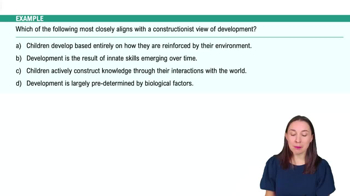
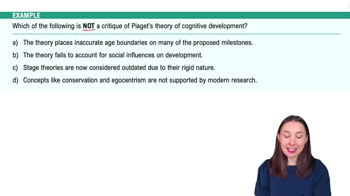
Piaget's Cognitive Developmental Theory Example 5
632
views
16
rank
VideoThumbView.guidedCourse
01:16
Piaget's Cognitive Developmental Theory Example 1
861
views
18
rank
VideoThumbView.guidedCourse
04:18
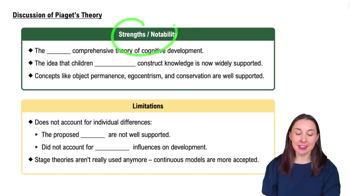
Discussion of Piaget's Theory
657
views
10
rank
Termini in questo insieme (15)
Nascondere definizioni
Cognitive Development
Progression of children's ability to think, reason, and understand, differing fundamentally from adult cognition.
Constructivist View
Perspective emphasizing children as active participants in building their understanding of the world.
Stage Theory
Model proposing that cognitive growth occurs in distinct, sequential phases with qualitative changes at each.
Sensory Motor Stage
First developmental period where infants learn through senses and movement, forming basic mental concepts.
Preoperational Stage
Second developmental period marked by use of mental symbols and imaginative play, but limited logical reasoning.
Concrete Operational Stage
Third developmental period where logical thinking about tangible objects emerges, but abstract reasoning is limited.
Formal Operational Stage
Final developmental period characterized by logical and abstract thinking, including hypothetical reasoning.
Schema
Mental framework or concept used to organize and interpret information about the world.
Assimilation
Process of applying existing mental frameworks to new experiences, often leading to quick but sometimes incorrect labeling.
Accommodation
Adjustment or modification of mental frameworks in response to new information or experiences.
Object Permanence
Understanding that objects and people continue to exist even when they are not visible.
Egocentrism
Difficulty in recognizing or understanding perspectives different from one's own, common in early childhood.
Conservation
Recognition that physical properties remain unchanged despite changes in appearance or arrangement.
Reversibility
Ability to mentally reverse actions or processes, supporting logical thinking and understanding of conservation.
Individual Differences
Variability in cognitive development rates and milestones among children, often overlooked in strict stage models.
 IndietroIndietro
 01:36
01:36