Skip to main content
Introduction to Psychology
Il mio corso
Impara
Preparazione agli esami
AI Tutor
Guide di studio
Flashcard
Esplora
Prova l'app
Il mio corso
Impara
Preparazione agli esami
AI Tutor
Guide di studio
Flashcard
Esplora
Prova l'app
Indietro
Sleep definitions
Puoi toccare per girare la carta.
Circadian Rhythm
Puoi toccare per girare la carta.
👆
Circadian Rhythm
Approximately 24-hour cycle regulating sleep and wakefulness, influenced by light and internal cues.
Avanzamenti del tracciato
I pulsanti di controllo sono stati cambiati in modalità "navigazione".
1/15
Flashcard correlate
Pratica correlata
Video consigliati
Sleep quiz #1
Sleep
38 Termini
Sleep quiz #2
Sleep
40 Termini
Sleep quiz #3
Sleep
22 Termini
Sleep
5. Consciousness and Sleep
7 Problemi
Argomento
Nicole
5. Consciousness and Sleep
1 Argomento
3 Problemi
Capitolo
Nicole
VideoThumbView.guidedCourse
00:11
Sleep Example 4
876
views
11
rank
VideoThumbView.guidedCourse
01:28
Sleep Example 2
1153
views
10
rank
VideoThumbView.guidedCourse
03:58
Basics of Sleep
1053
views
13
rank
Termini in questo insieme (15)
Nascondere definizioni
Circadian Rhythm
Approximately 24-hour cycle regulating sleep and wakefulness, influenced by light and internal cues.
Suprachiasmatic Nucleus
Hypothalamic structure receiving light signals, coordinating timing of sleep and wake cycles.
Pineal Gland
Small endocrine gland releasing melatonin in response to signals from the brain to promote drowsiness.
Melatonin
Hormone increasing drowsiness, released in darkness to help initiate sleep.
Sleep Cycle
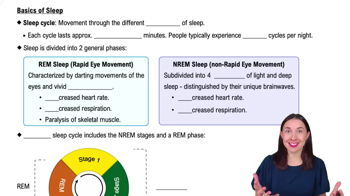
Repeated pattern of NREM and REM stages, lasting 90–120 minutes, occurring multiple times nightly.
REM Sleep
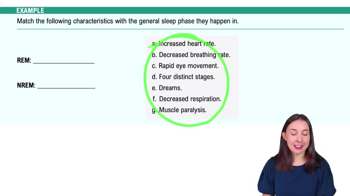
Sleep phase with rapid eye movement, vivid dreaming, muscle paralysis, and brain activity resembling wakefulness.
NREM Sleep
Non-rapid eye movement sleep, divided into four stages, featuring progressively deeper sleep and slower brain waves.
Electroencephalogram
Device recording electrical brain activity, used to distinguish sleep stages by wave patterns.
Beta Waves
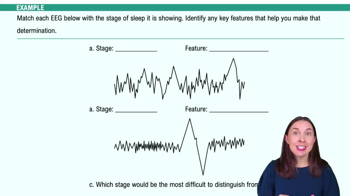
High-frequency, low-amplitude brain activity seen during wakefulness and REM sleep.
Theta Waves
Lower-frequency brain activity marking light sleep, especially stage 1.
Sleep Spindles
Brief bursts of very high-frequency brain activity, characteristic of stage 2 sleep.
K-Complexes
Sudden, high-amplitude EEG spikes, unique to stage 2 sleep.
Delta Waves
Very high-amplitude, low-frequency brain activity, dominant in deep sleep stages 3 and 4.
Amplitude
Height of EEG waves, indicating strength of brain activity during different sleep stages.
Frequency
Number of EEG wave cycles per second, used to differentiate sleep and wake states.
 IndietroIndietro
 00:11
00:11