Skip to main content
Introduction to Psychology
Il mio corso
Impara
Preparazione agli esami
AI Tutor
Guide di studio
Flashcard
Esplora
Prova l'app
Il mio corso
Impara
Preparazione agli esami
AI Tutor
Guide di studio
Flashcard
Esplora
Prova l'app
Indietro
Stress and Immune Function definitions
Puoi toccare per girare la carta.
Immune System
Puoi toccare per girare la carta.
👆
Immune System
A complex body network responsible for defending against bacteria, viruses, and other pathogens to maintain health.
Avanzamenti del tracciato
I pulsanti di controllo sono stati cambiati in modalità "navigazione".
1/15
Flashcard correlate
Pratica correlata
Video consigliati
Stress and Immune Function quiz #1
Stress and Immune Function
15 Termini
Stress and Immune Function
13. Stress and Health
7 Problemi
Argomento
Nicole
General Adaptation Syndrome
13. Stress and Health
7 Problemi
Argomento
Nicole
13. Stress and Health
4 Argomenti
12 Problemi
Capitolo
Nicole
VideoThumbView.guidedCourse
01:01
Example 1
385
views
5
rank
VideoThumbView.guidedCourse
03:18
Stress and Immune Function
460
views
4
rank
Termini in questo insieme (15)
Nascondere definizioni
Immune System
A complex body network responsible for defending against bacteria, viruses, and other pathogens to maintain health.
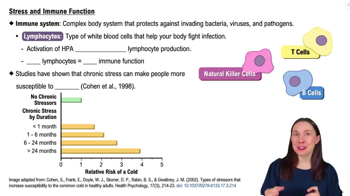
Lymphocytes
Specialized white blood cells essential for fighting infections, including several distinct types with unique roles.
White Blood Cell
A cellular component of blood that plays a central role in protecting the body from infectious agents.
Pathogen
Any microorganism, such as bacteria or viruses, capable of causing disease within the body.
HPA Axis
A hormonal system activated by stress, influencing bodily functions through the release of specific hormones.
Cortisol
A hormone released during stress that signals the body to suppress nonessential functions, including immune responses.
Chronic Stress
A prolonged state of psychological or physiological strain lasting weeks, months, or even years.
Immune Suppression
A reduction in the body's ability to defend against infections, often resulting from hormonal changes during stress.
Susceptibility
An increased likelihood of developing illnesses, such as colds, especially when immune defenses are compromised.
Infection
The invasion and multiplication of harmful microorganisms in the body, potentially leading to illness.
Relative Risk
A measure comparing the probability of an event, like illness, between groups exposed to different conditions.
Nonessential Function
Bodily processes deprioritized during stress to conserve energy for immediate survival needs.
Natural Killer Cell
A type of lymphocyte involved in the rapid response to infected or abnormal cells within the body.
B Cell
A lymphocyte subtype that contributes to immune defense by producing antibodies against pathogens.
T Cell
A lymphocyte subtype that assists in directly attacking infected cells and coordinating immune responses.
 IndietroIndietro
 01:01
01:01