Skip to main content
Introduction to Psychology
Il mio corso
Impara
Preparazione agli esami
AI Tutor
Guide di studio
Flashcard
Esplora
Prova l'app
Il mio corso
Impara
Preparazione agli esami
AI Tutor
Guide di studio
Flashcard
Esplora
Prova l'app
Indietro
The Hindbrain quiz
Puoi toccare per girare la carta.
What vital autonomic functions does the medulla control?
Puoi toccare per girare la carta.
👆
What vital autonomic functions does the medulla control?
The medulla controls breathing, heart rate, blood pressure, and basic reflexes like coughing and sneezing.
Avanzamenti del tracciato
I pulsanti di controllo sono stati cambiati in modalità "navigazione".
1/15
Flashcard correlate
Pratica correlata
Video consigliati
The Hindbrain definitions
The Hindbrain
14 Termini
The Hindbrain
3. Biological Psychology
7 Problemi
Argomento
Nicole
The Cortical Forebrain
3. Biological Psychology
7 Problemi
Argomento
Nicole
3. Biological Psychology - Part 1 of 2
5 Argomenti
14 Problemi
Capitolo
Nicole
3. Biological Psychology - Part 2 of 2
5 Argomenti
12 Problemi
Capitolo
Nicole
VideoThumbView.guidedCourse
05:18
The Hindbrain
1018
views
14
rank
VideoThumbView.guidedCourse
02:00
The Hindbrain Example 1
801
views
9
rank
Termini in questo insieme (15)
Nascondere definizioni
What vital autonomic functions does the medulla control?
The medulla controls breathing, heart rate, blood pressure, and basic reflexes like coughing and sneezing.
Which hindbrain structure is primarily responsible for regulating the sleep-wake cycle and REM sleep?
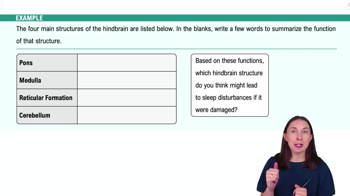
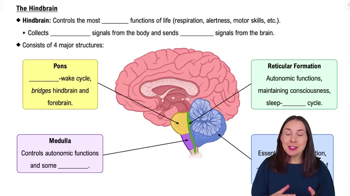
The pons is primarily responsible for regulating the sleep-wake cycle and REM sleep.
What is the main function of the reticular formation in the hindbrain?
The reticular formation maintains consciousness, alertness, and arousal, and also helps regulate autonomic functions.
How does the cerebellum contribute to movement?
The cerebellum coordinates precise movements, balance, and the timing of movements.
Why is the pons referred to as a 'bridge' in the brain?
The pons is called a 'bridge' because it connects the hindbrain and forebrain, routing signals between them.
Which structure in the hindbrain is most involved in the 'wake' side of the sleep-wake cycle?
The reticular formation is most involved in maintaining wakefulness and alertness.
What does the cerebellum's name mean in Latin, and why?
Cerebellum means 'little brain' in Latin because it looks like a small brain tucked under the main brain.
What basic reflexes are controlled by the medulla?
The medulla controls reflexes such as coughing and sneezing.
How does the hindbrain act as a bridge between the spinal cord and forebrain?
The hindbrain relays sensory signals from the spinal cord to the forebrain and motor signals from the forebrain to the spinal cord.
Which hindbrain structure is especially important for the coordination and precision of movement?
The cerebellum is especially important for coordination and precision of movement.
What role does the pons play in sleep?
The pons helps regulate the stages of sleep and is crucial for entering REM sleep.
Which two hindbrain structures does the reticular formation pass through?
The reticular formation passes through the medulla and the pons.
What are the four major structures of the hindbrain?
The four major structures are the medulla, pons, reticular formation, and cerebellum.
What is the primary function of the hindbrain as a whole?
The hindbrain controls basic life functions such as respiration, alertness, and motor skills, and integrates sensory and motor signals.
How do the functions of the pons and reticular formation differ in the sleep-wake cycle?
The pons is more involved in sleep and REM sleep, while the reticular formation is more involved in wakefulness and alertness.
 IndietroIndietro
 05:18
05:18