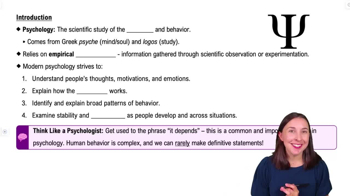
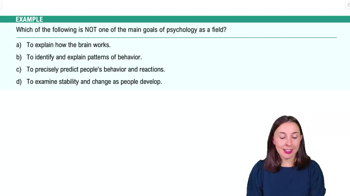
Why do some people think psychology is a humanity? Is it?
Some view psychology as a humanity because it studies human experience and behavior, but psychology is primarily a science that uses empirical methods to understand mental processes.
Why is psychology considered a social science?
Psychology is a social science because it studies human behavior and social interactions using scientific methods.
Why is psychology considered a natural science?
Psychology is considered a natural science because it studies biological and physiological processes underlying behavior.
Why is psychology called a bridge science?
Psychology bridges natural and social sciences by integrating biological, psychological, and social perspectives.
What makes the psychology major unique?
The psychology major is unique for its interdisciplinary approach, combining scientific methods with understanding human behavior and mental processes.
What are the five core goals for psychology major programs?
The goals include understanding behavior, applying scientific methods, developing critical thinking, gaining research skills, and preparing for diverse careers.
What specific skills do employers prefer in psychology majors?
Employers prefer skills in critical thinking, research methods, communication, data analysis, and an appreciation for human diversity.
What are three benefits of the psychology major discussed in the lesson?
Benefits include transferable skills, diverse career options, and a strong foundation for graduate study.
What do undergraduate research assistants do?
They assist with data collection, literature reviews, and supporting research projects under faculty supervision.
What do undergraduate teaching assistants do?
They help with grading, leading discussion sections, and supporting instructors in course delivery.
What are the three kinds of psychology-related internships?
Internships can be research-based, clinical/practical, or organizational/industry-focused.
What are the trade-offs of having a psychology-related internship?
Trade-offs include time commitment versus gaining practical experience and networking opportunities.
What does psychological literacy include?
Psychological literacy includes understanding psychological concepts, applying critical thinking, and using scientific reasoning.
What are the 12 transferable skills employers seek from psychology majors?
Skills include communication, problem-solving, data analysis, teamwork, ethical judgment, and adaptability.
What are the three types of skills psychology majors should possess according to O’Hare and McGuiness?
They are technical skills, interpersonal skills, and conceptual skills.
What are the top six reasons new collegiate hires are fired according to Gardner?
Reasons include poor communication, lack of teamwork, unreliability, poor attitude, inability to learn, and ethical issues.
Who qualifies as part of the psychology workforce?
Individuals working in roles applying psychological knowledge, including researchers, clinicians, counselors, and organizational psychologists.
What is 'task significance' in work meaning?
Task significance is the perception that one's work has a meaningful impact on others.
What is the difference between aligned and misaligned psychology students?
Aligned students have clear goals matching their interests and skills; misaligned students lack this fit and may struggle to find direction.
What do social psychologists study and what entry-level jobs suit them?
They study social behavior and attitudes; jobs include market research, human resources, and social services.
What do developmental psychologists study and what jobs suit them?
They study human growth across the lifespan; jobs include education, child development, and counseling.
What do neuroscientists study and what entry-level jobs suit them?
They study the nervous system and brain; jobs include research assistant, lab technician, and clinical support roles.
What do cognitive psychologists study and what jobs suit them?
They study mental processes like memory and perception; jobs include UX research, data analysis, and academic research.
What do industrial/organizational psychologists study and what jobs suit them?
They study workplace behavior; jobs include HR specialist, organizational consultant, and training coordinator.
What jobs are available for clinical or counseling psychology interests?
Jobs include counselor, clinical assistant, social worker, and therapist roles.
What are the educational differences between psychiatrists, clinical psychologists, and counselors?
Psychiatrists attend medical school; clinical psychologists earn doctoral degrees; counselors typically have master's degrees.
What are interpersonal competencies according to Yancey and colleagues?
Competencies include communication, empathy, teamwork, and conflict resolution.
What are tips for successful interviewing in psychology careers?
Tips include researching the role, practicing responses, demonstrating skills, and showing enthusiasm.
What factors lead to promotions at work according to Gardner?
Factors include performance, interpersonal skills, reliability, and adaptability.
 Indietro
 01:11
01:11