 Indietro
Glash
 01:11
01:11
Termini in questo insieme (54)
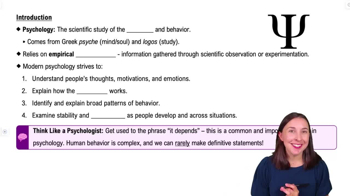
Psychology is the scientific study of behavior and mental processes.
Curiosity, skepticism, and humility are the three elements of the scientific attitude.
Critical thinking is the careful evaluation of evidence before accepting conclusions. Example: questioning assumptions rather than accepting them at face value.
Positive psychology studies human strengths and flourishing to promote well-being.
Humanistic psychology emphasizes personal growth and self-actualization.
Behaviorism studies observable behavior and its environmental determinants.
Evolutionary psychology examines how natural selection shapes behavior and mental processes.
Positive correlation: same direction; negative correlation: two different directions; zero correlation: no relationship.
Hindsight bias is the tendency to believe, after learning an outcome, that one would have predicted it.
Case study: in-depth study of one individual; naturalistic observation: observing behavior in natural settings; experiment: manipulating variables to determine cause; survey: collecting self-reported data from many people.
Independent variable is manipulated; dependent variable is measured; confounding variables are controlled.
Double-blind procedure: neither participants nor researchers know who receives treatment; placebo effect: improvement due to expectations, not treatment.
The normal curve is a symmetrical, bell-shaped distribution representing many natural phenomena.
Descriptive statistics summarize data; inferential statistics make predictions or inferences about a population based on a sample.
Mean: average; median: middle value; mode: most frequent value.
Range is the difference between highest and lowest scores; standard deviation measures average distance from the mean.
Neurotransmitters are chemical messengers that transmit signals across synapses between neurons.
The threshold is the minimum level of stimulation required to trigger an action potential in a neuron.
Dendrites receive signals; axon sends signals; myelin sheath insulates axons to speed transmission.
Endorphins are neurotransmitters that reduce pain and promote pleasure.
Motor neurons carry signals from brain to muscles; sensory neurons carry signals from senses to brain; interneurons process info between the sensory and motor neurons connect neurons within the brain and spinal cord.
Sympathetic activates fight-or-flight; parasympathetic promotes rest and digestion after fight or flight.
Hypothalamus regulates body functions and hormones; pituitary gland controls other endocrine glands; adrenal glands produce stress hormones fight or flight
EEG records electrical brain activity, electrodes and gel; fMRI measures brain activity via blood flow; PET tracks radioactive glucose consumption in the brain.
Amygdala: emotion processing; hippocampus: maintenance activities, emotion and reward, pituitary gland, memory formation; medulla: controls heartbeat and breathing; pons: coordinate movement, regulates sleep and arousal.
Frontal lobe: speaking, impulse, muscle, decision making; parietal lobe: sensory processing; occipital lobe: vision; temporal lobe: hearing and memory.
Corpus callosum connects the left and right brain hemispheres, allowing communication between them.
Left hemisphere: language and math; right hemisphere: inferences, speech, self-awarness, perceptual.
Consciousness is our awareness of ourselves and our environment.
Selective attention focuses awareness on a particular stimulus; inattentional blindness is missing visible objects when attention is elsewhere; change blindness is failing to notice changes in the environment.
Parallel processing handles multiple tasks simultaneously; sequential processing handles tasks one at a time.
Circadian rhythm is the 24-hour biological clock regulating sleep and body temperature fluctuations. Rise in morning, peaks in day, dips in afternoon, and drops in evening
Alpha waves: slow relaxed, awake N1: light or images (hypnagogic) N2; small bursts of brain activity (sleep spindles) N3 Delta waves: large, slow waves, deep sleep Rem sleep, rapid eye movement, one hour into sleep, muscles relax, other systems active, longer periods of rem through the night
Sleep apnea: breathing interruptions; night terrors: intense fear during sleep; insomnia: difficulty falling or staying asleep.
Genome: complete instructions for making an organism, genetic material; chromosomes: DNA structures 23 pairs; behavior genetics: study of genetic influence on behavior; epigenetics: study of gene expression changes without DNA alteration by the environment, epigentic marks.
Temperament is a person's characteristic emotional reactivity and intensity, which is stable over time.
Heritability is the proportion of variation in a trait attributable to genetic factors within a population.
Identical twins share more similarities in personality, intelligence, and behaviors due to identical genes.
Pruning is the brain's process of eliminating unused neural connections to improve efficiency.
Parents influence values and attitudes, extremes; peers influence behaviors and social skills, development; selection effect is choosing peers with similar interests.
Culture shock is the disorientation experienced when encountering a new culture.
Loose cultures have relaxed social norms; tight cultures have strict social norms and low tolerance for deviance.
Males tend to show more physical aggression; females tend to show more relational aggression.
Bottom-up processing starts with sensory input; top-down processing uses prior knowledge to interpret sensory information.
Absolute threshold is the minimum stimulus detectable; difference threshold is the smallest detectable difference between stimuli.
Perceptual sets are mental predispositions to perceive stimuli in a certain way; stereotypes are generalized beliefs about groups.
Sensory adaptation is the diminished sensitivity to a stimulus after constant exposure.
Subliminal sensation is detecting stimuli below conscious awareness; it can influence attitudes subtly.
Heuristics are mental shortcuts; availability heuristic judges likelihood by ease of recall; representativeness heuristic judges by similarity to a prototype.
Confirmation bias is the tendency to seek information that supports existing beliefs.
Overconfidence is overestimating the accuracy of one’s knowledge or judgments.
Belief perseverance is maintaining beliefs despite contradictory evidence.
Framing is how information is presented, which can influence decisions and judgments.
Divergent thinking generates many possible solutions; convergent thinking narrows down to the best solution.