 Indietro
Introduction to Psychology: Early Concepts and Neuroscience
 05:16
05:16
Termini in questo insieme (29)
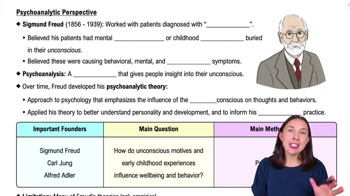
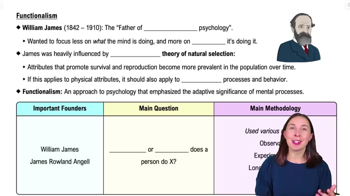
Early pioneers like Wilhelm Wundt established psychology as a science, William James emphasized functionalism, and Sigmund Freud developed psychoanalysis.
Gestalt psychology focuses on perceiving whole patterns rather than individual components, emphasizing that the whole is different from the sum of its parts.
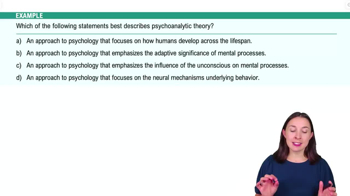
Psychoanalysis explores unconscious motives and conflicts, emphasizing early childhood experiences and the role of the unconscious mind.
Behaviorism studies observable behavior and the effects of learning, rejecting introspection and focusing on stimulus-response relationships.
The perspectives include biological, behavioral, cognitive, humanistic, psychodynamic, sociocultural, and evolutionary approaches.
Includes clinical psychologists, counselors, psychiatrists, researchers, and school psychologists, each with different roles and training.
Involves skepticism, open-mindedness, careful evaluation of evidence, and avoiding emotional reasoning.
Steps are: 1. Formulate a question, 2. Develop a hypothesis, 3. Test the hypothesis, 4. Draw conclusions, 5. Report results.
Include naturalistic observation, case studies, surveys, and laboratory observation.
Measures the relationship between two or more variables without implying causation, using correlation coefficients.
Include selecting participants, assigning groups, manipulating variables, measuring outcomes, and analyzing data.
Include placebo effects, experimenter bias, and confounding variables. Controlled by blinding and random assignment.
Include informed consent, confidentiality, protection from harm, and debriefing.
Animals allow study of biological processes and behaviors not possible or ethical to study in humans.
Dendrites receive signals, axon transmits impulses, myelin sheath speeds transmission, and axon terminals send messages to other neurons.
An electrical impulse that travels down the axon, enabling neuron communication.
Neurons release neurotransmitters into synapses, which bind to receptors on other neurons to transmit signals.
Lesioning involves damaging brain areas to study function; brain stimulation activates areas to observe effects on behavior.
Structural: MRI, CT scans; Functional: fMRI, PET scans.
Medulla controls vital functions, pons regulates sleep and arousal, cerebellum coordinates movement.
Amygdala (emotion), hippocampus (memory), hypothalamus (motivation).
Occipital lobe processes vision, temporal lobe processes hearing, parietal lobe processes touch, frontal lobe controls movement.
Integrate information from different senses and are crucial for language, thinking, and problem-solving.
Left hemisphere is typically language and logic focused; right hemisphere is more involved in spatial and creative tasks.
The brain and spinal cord work together to process information and respond to injury or experience.
Somatic system controls voluntary movements; autonomic system regulates involuntary functions like heartbeat.
It controls other endocrine glands by releasing hormones that regulate growth and metabolism.
Include thyroid (metabolism), adrenal glands (stress response), and pancreas (blood sugar regulation).
Include behavioral therapy, medication, structured routines, and environmental modifications.