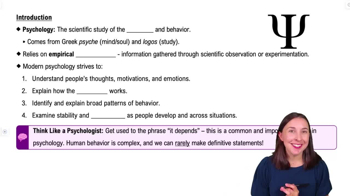
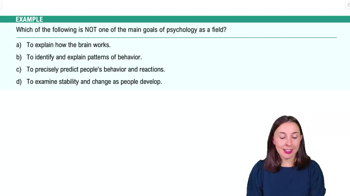
Psychology helps us understand behavior and mental processes.
Define psychology.
Psychology is the scientific study of behavior and mental processes.
Define behavior.
Behavior refers to any observable action made by a living person or animal.
Define mental processes.
Mental processes are internal, subjective experiences such as thoughts, feelings, and perceptions.
Who was Wilhelm Wundt and what did he do?
Wilhelm Wundt is known as the father of psychology. He established the first psychology laboratory and studied consciousness using objective introspection.
What is objective introspection?
Objective introspection is the process of examining and measuring one's own thoughts and mental activities.
Who was Edward Titchener and what did he do?
Edward Titchener was a student of Wundt who founded structuralism, focusing on breaking down mental processes into basic components.
What is structuralism?
Structuralism is the study of the structure of the mind by analyzing its components through introspection.
Who was William James and what did he do?
William James founded functionalism, emphasizing the purpose of consciousness and behavior in helping people adapt to their environment.
What is functionalism?
Functionalism studies how mental processes help individuals adapt to their environment.
How was William James influenced by Darwin?
James was influenced by Darwin's theory of natural selection, applying it to understand how mental processes aid survival.
Who was Mary Whiton Calkins?
Mary Whiton Calkins was a pioneering female psychologist who studied memory and became the first female president of the American Psychological Association.
What is Gestalt psychology?
Gestalt psychology focuses on perceiving whole patterns rather than individual components.
Who was Max Wertheimer?
Max Wertheimer was a founder of Gestalt psychology, emphasizing that the whole is different from the sum of its parts.
What is cognitive psychology?
Cognitive psychology studies mental processes such as thinking, memory, and problem-solving.
What is psychoanalysis?
Psychoanalysis is a theory and therapy focusing on unconscious motives and conflicts, founded by Sigmund Freud.
Who was Sigmund Freud and what did he do?
Sigmund Freud founded psychoanalysis, emphasizing the role of the unconscious mind in behavior and personality.
What causes nervous disorders according to Freud?
Freud believed nervous disorders were caused by unconscious conflicts and repressed feelings.
What is behaviorism?
Behaviorism is the study of observable behavior, emphasizing learning through conditioning.
Who was Ivan Pavlov and what did he do?
Ivan Pavlov was a behaviorist known for discovering classical conditioning through experiments with dogs.
Who was John B. Watson?
John B. Watson was a founder of behaviorism who emphasized studying observable behavior and conducted the Little Albert experiment.
What are the seven modern perspectives in psychology?
The seven perspectives include biological, behavioral, cognitive, humanistic, psychodynamic, sociocultural, and evolutionary approaches.
What is critical thinking in psychology?
Critical thinking involves analyzing information carefully to avoid bias and faulty conclusions.
What are the four basic criteria for critical thinking?
The criteria are examination of assumptions, evaluation of evidence, discernment of hidden values, and assessment of conclusions.
What is the scientific approach in psychology?
The scientific approach uses systematic observation and experimentation to understand behavior and mental processes.
What are descriptive research methods?
Descriptive methods include naturalistic observation, laboratory observation, case studies, and surveys to gather data without manipulating variables.
What is naturalistic observation?
Naturalistic observation involves watching behavior in its natural environment without interference.
What is a case study?
A case study is an in-depth analysis of an individual or group, such as the famous case of Phineas Gage.
 Indietro
 01:11
01:11