 Indietro
Introduction to Psychology Exam 1 Study Guide
 01:11
01:11
Termini in questo insieme (20)
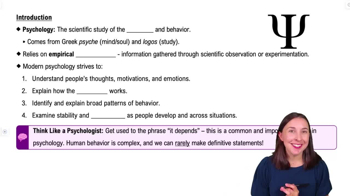
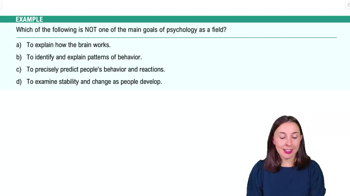
Psychology is the scientific study of behavior and mental processes.
Curiosity, skepticism, and humility are the three elements of the scientific attitude.
Critical thinking involves analyzing and evaluating evidence before accepting conclusions. Example: questioning the validity of a study's results.
Positive psychology studies human strengths and flourishing to promote well-being.
Humanistic psychology emphasizes personal growth and self-actualization.
Behaviorism studies observable behavior and its environmental determinants.
Evolutionary psychology examines how natural selection shapes behavior and mental processes.
Positive correlation: variables increase together; negative correlation: one increases as the other decreases; zero correlation: no relationship.
Hindsight bias is the tendency to believe, after learning an outcome, that one would have predicted it.
Case study: in-depth analysis of one individual; naturalistic observation: observing behavior in natural settings; experiment: manipulating variables to determine cause; survey: collecting self-reported data from many people.
Independent variable is manipulated; dependent variable is measured; confounding variables are controlled.
Double-blind procedure: neither participants nor researchers know who receives treatment; placebo effect: improvement due to expectations, not treatment.
The normal curve is a symmetrical, bell-shaped distribution where most scores cluster around the mean.
Descriptive statistics summarize data; inferential statistics make predictions or inferences about a population based on a sample.
Mean: average; median: middle score; mode: most frequent score.
Range: difference between highest and lowest scores; standard deviation: average distance of scores from the mean.
Neurotransmitters are chemical messengers that transmit signals across synapses between neurons.
The threshold is the minimum level of stimulation required to trigger an action potential in a neuron.
Dendrites receive signals; axon transmits signals; myelin sheath insulates axons to speed transmission.
Sympathetic activates fight-or-flight responses; parasympathetic promotes rest and digestion.