 Indietro
Introduction to Psychology Key Concepts

 01:11
01:11
Termini in questo insieme (31)
Functionalism is a psychological theory that focuses on how mental processes help individuals adapt to their environment.
Behaviorism studies observable behavior and emphasizes the role of environmental stimuli in shaping behavior.
The psychodynamic perspective focuses on unconscious drives and conflicts influencing behavior.
The humanistic perspective emphasizes personal growth, free will, and self-actualization.
The cognitive perspective studies mental processes like thinking, memory, and problem-solving.
The biopsychological perspective examines how biology, such as brain structures and chemicals, affects behavior.
The evolutionary perspective explains behavior through natural selection and adaptation over time.
The scientific method is a systematic process for conducting research and acquiring knowledge.
A hypothesis is a testable prediction about the relationship between variables.
A case study is an in-depth analysis of an individual or group to explore psychological phenomena.
A representative sample accurately reflects the characteristics of the larger population.
Correlation measures the relationship between two variables but does not imply causation.
An experiment tests cause-and-effect relationships by manipulating an independent variable and measuring a dependent variable.
An operational definition specifies how variables are measured or manipulated in a study.
The independent variable is the factor that is changed or controlled in an experiment.
The dependent variable is the outcome measured in response to changes in the independent variable.
Descriptive statistics summarize and describe data, such as mean, median, and mode.
Inferential statistics allow conclusions about populations based on sample data.
The mean is the average value of a data set.
The mode is the most frequently occurring value in a data set.
The median is the middle value when data are ordered from least to greatest.
Standard deviation measures the amount of variation or dispersion in a data set.
Statistically significant results are unlikely to have occurred by chance.
Reliability refers to the consistency of a research study or measuring test.
Validity indicates how well a test measures what it is supposed to measure.
Psychoanalysis is a therapeutic approach focusing on unconscious motives and conflicts.
Naturalistic observation involves observing behavior in its natural environment without interference.
Surveys collect self-reported data from a sample to generalize about a population.
Ethics are moral principles guiding research to protect participants' rights and well-being.
An experimenter is the person conducting the research study.
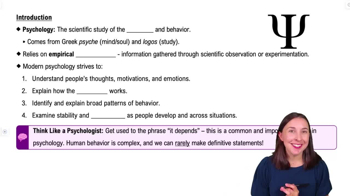
A psychologist studies mental processes and behavior scientifically.