 Indietro
Introduction to Psychology Key Concepts
 01:11
01:11
Termini in questo insieme (22)
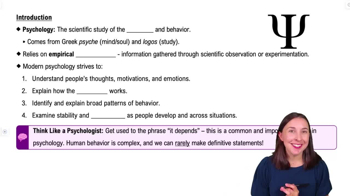
Psychology is the scientific study of the mind, brain, and behaviour, analyzed at biological, psychological, and social levels.
Psychology studies behaviour from biological (molecules, brain structure), psychological (thoughts, feelings), to social (relationships, culture) levels.
Challenges include: behaviour is multiply determined, influences are interdependent, individual differences, reciprocal influence, and cultural shaping of behaviour.
Common sense is limited by naive realism and biases; what seems obvious may be false, like the earth appearing flat or still.
Psychology uses scientific methods to generate and test hypotheses, focusing on evidence rather than just common sense or beliefs.
A theory explains many findings; a hypothesis is a testable prediction derived from a theory.
The tendency to seek or favor evidence that supports our beliefs while ignoring contradictory evidence.
Continuing to hold onto initial beliefs even when faced with strong contradictory evidence.
Claims that appear scientific but lack evidence and fail to correct for bias or self-correct with new data.
Includes overuse of ad hoc hypotheses, lack of self-correction, and reliance on anecdotes instead of systematic evidence.
Humans' tendency to detect meaningful patterns in random data, sometimes leading to false beliefs like the placebo effect.
Improvement in symptoms due to expectations from a treatment with no active medical ingredient, measurable by comparing placebo and control groups.
Include ruling out rival hypotheses, correlation vs causation, falsifiability, replicability, extraordinary claims require extraordinary evidence, and Occam's razor.
Early school by Wundt and Titchener aiming to identify basic elements of psychological experience using introspection.
William James' approach focusing on the adaptive purposes of psychological traits, influenced by natural selection.
Watson and Skinner's focus on observable behaviour and learning principles, emphasizing environmental influences.
Study of mental processes underlying thinking, memory, and perception, led by Piaget and Neisser.
Freud and Jung's theory emphasizing unconscious mental processes influencing behaviour.
Includes clinical, counselling, school, developmental, experimental, biopsychology, forensic, and industrial-organizational psychology.
Discussion on whether behaviour is shaped more by genetics (nature) or environment (nurture).
Debate on whether humans have free will or if behaviour is determined by environmental or biological factors.
Basic research explores how the mind works; applied research uses this knowledge to solve real-world problems.