 Indietro
Introduction to Psychology Key Concepts
 01:11
01:11
Termini in questo insieme (29)
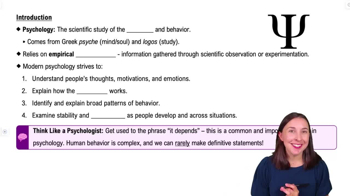
Psychology is the study of how we act and what happens inside our heads, including behavior and thought processes.
Behavior refers to what we can observe happening externally.
Thought processes involve how we think, organize information, feel, and understand things, which are harder to observe.
Biopsychology studies the biological factors like genetics, brain structures, nervous system, and hormones that influence behavior and mental processes.
Genetics, brain's nervous system, hormones, and brain structures.
By examining if the person has low hormone levels affecting mood and brain function.
Cognition is the study of mental processes like thinking, memory, problem-solving, and decision-making.
Nature refers to inherited genetic traits, while nurture refers to environmental influences on behavior and development.
Epigenetics studies how environmental factors can affect gene expression without changing the DNA sequence.
Multicultural, Behavioral, Cognitive, Biological/Biopsychology, Humanistic, Psychoanalysis/Psychodynamic.
It focuses on observable behaviors learned through conditioning, reinforcement, and punishment.
Wilhelm Wundt from Germany is the father of psychology for founding the first psychology lab in 1879 to study conscious experience scientifically.
The unconscious consists of thoughts, feelings, and memories below the level of conscious awareness.
Neurons are cells that transmit information within the nervous system through electrical and chemical signals.
Sensory neurons carry information from senses to the brain; motor neurons carry messages from the brain to muscles.
Chemical messengers that travel across synapses to transmit signals between neurons.
The CNS includes the brain and spinal cord, processing and sending information throughout the body.
The PNS connects the CNS to the rest of the body, including voluntary and involuntary control systems.
The somatic nervous system controls voluntary movements; the autonomic nervous system controls involuntary functions like heart rate.
The sympathetic division activates the body during stress; the parasympathetic division calms the body down.
The pituitary gland is the master gland that produces growth hormone and regulates other glands.
Occipital (vision), Temporal (hearing and speech), Parietal (touch and perception), Frontal (complex thinking and planning).
Neurogenesis is the process of creating new neurons in the brain.
A method where participants are assigned to experimental or control groups by chance to reduce bias.
When participants experience changes due to expectations rather than the experimental treatment.
Question, Literature Review, Hypothesis, Data Collection, Analyzing Data and Drawing Conclusions.
Glial cells support, protect, nourish neurons, and provide myelin in the nervous system.
Neurons that connect nearby neurons within the central nervous system without extending to the body.
EEG, CT, MRI, PET, and fMRI are used to study brain structure and activity.