 Indietro
Introduction to Psychology: Key Concepts and Historical Perspectives
 01:11
01:11
Termini in questo insieme (29)
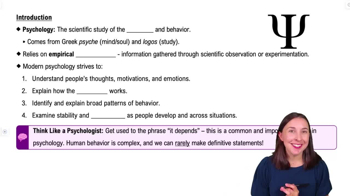
the scientific study of the mind and behavior, exploring human cognition and actions through empirical evidence
The term comes from Greek: psyche meaning mind or soul, and logos meaning study, signifying the study of the soul.
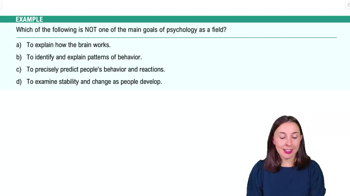
To understand thoughts, motivations, and emotions; explore brain and nervous system functions; identify behavior patterns; and examine stability and change across the lifespan.
Founded the first psychology lab in 1879, focused on immediate conscious experience, and established psychology as a scientific discipline.
Early school of thought aiming to analyze the basic elements of consciousness using introspection, pioneered by Wundt and Titchener.
A technique where participants report their immediate sensory experiences to study conscious thought, though limited by subjectivity.
Humans perceive whole patterns rather than isolated parts; the whole is greater than the sum of its parts.
Studied motion perception and developed Principles of Perceptual Organization, showing how frame rates affect visual experience.
Emphasizes the study of observable behavior and the stimulus-response relationship, rejecting introspection.
Learning process where a neutral stimulus becomes associated with an unconditioned stimulus to elicit a conditioned response.
Behavior modification through reinforcement or punishment, emphasizing active behavior selection based on consequences.
Studies psychological changes and stability across the lifespan, recognizing unique cognitive processes at different ages.
Explains children's cognitive development by studying their reasoning processes and thinking patterns at different ages.
How social environments influence individual thoughts, behaviors, attitudes, and stereotypes.
Focused on leadership, communication, and social change, founding the Research Center for Group Dynamics.
Focuses on mental processes like perception, memory, language, and problem-solving, marking the cognitive revolution.
Found that short-term memory capacity is about seven items, plus or minus two.
Challenged behaviorist views on language acquisition, emphasizing innate cognitive structures.
Studies how natural selection shaped psychological traits and behaviors for survival and reproduction.
Brains are wired to associate certain stimuli more easily, like taste with nausea, aiding survival.
How culture shapes human behavior and mental processes, emphasizing the importance of cultural context.
Examines relationships between ecology, culture, cognition, and behavior, including acculturation processes.
Begins with a theory, followed by hypothesis formulation, data collection, analysis, and peer-reviewed publication.
Studies the same individuals over time to observe development and establish temporal precedence.
Compares different age groups at one point in time, providing a snapshot but not individual development.
Include mean, median, and mode, which summarize typical values in a dataset.
The mean is sensitive to outliers, while the median is robust and better represents central tendency when outliers exist.
Parenthetical citations include author and date in parentheses; narrative citations integrate them into the sentence.
Include authors' names, publication date, article title, journal name (italicized), volume, issue, pages, and DOI or URL.