 Indietro
Introduction to Psychology: Key Concepts and Research Methods
 03:03
03:03
Termini in questo insieme (30)
A method where a facilitator helps autistic children communicate by typing, but controlled studies showed messages originated from the facilitator, not the child.
A surgical treatment for severe mental disorders that severs connections between the frontal lobe and thalamus; later shown to be ineffective and harmful.
Intuitive, fast, effortless thinking that relies on heuristics and snap judgments.
Analytical, slow, and effortful thinking used for problem solving and controlled reasoning.
Mental shortcuts or rules of thumb that simplify decision-making but can lead to errors when oversimplifying reality.
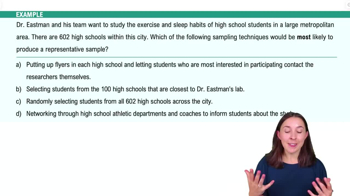
Every person in the population has an equal chance of being chosen for a study, essential for generalizing results.
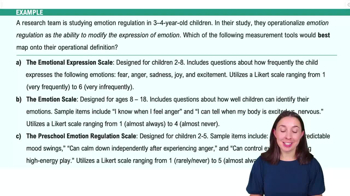
Consistency of a measure; includes test-retest and interrater reliability.
The extent to which a test measures what it claims; a test must be reliable to be valid but can be reliable and invalid.
Sharing data publicly, preregistering studies, encouraging replication, and publishing sound science regardless of outcome.
Watching behavior in real-world settings; high external validity but low internal validity, so no cause-effect conclusions.
In-depth study of one or few individuals, useful for rare conditions but limited in generalizability.
Participants assess their own traits or opinions; easy to use but vulnerable to bias, phrasing effects, and dishonesty.
Reports from people who know the subject, avoiding some self-report biases but subject to halo and horns effects.
Tendency to let one positive trait influence ratings of other traits (e.g., attractive people seen as smarter).
Tendency to let one negative trait influence ratings of other traits (e.g., mean people seen as less intelligent).
A number between -1 and +1 indicating the strength and direction of a relationship between two variables.
Perceiving a relationship between variables when none exists, often due to stereotypes or superstitions.
Correlation does not imply causation; causation can only be inferred through experimental designs.
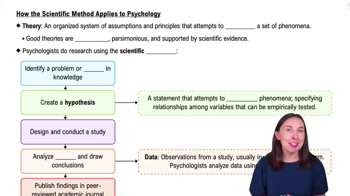
Research method involving random assignment to experimental or control groups, manipulation of an independent variable, and measurement of a dependent variable.
Different groups receive different treatments; comparisons are made between groups.
The same group receives multiple treatments; each participant acts as their own control.
Any variable other than the independent variable that differs between groups and may affect the outcome.
Improvement due to participants' expectations rather than the treatment itself; controlled by blinding participants.
Negative effects caused by the expectation of harm rather than the treatment.
Researcher bias unintentionally influencing study outcomes; prevented by double-blind designs.
Cues that allow participants to guess the study's purpose, potentially biasing their behavior.
Participants must be fully informed about the study and voluntarily agree to participate, with the right to withdraw anytime.
Deception in research must be disclosed as soon as possible, and participants must be fully debriefed after the study.
Numerical summaries of data including measures of central tendency (mean, median, mode) and variability (range, standard deviation).
Methods to determine if findings from a sample can be generalized to the population, including tests of statistical significance.