Indietro

Introduction to Psychology - Key Concepts and Theories

I pulsanti di controllo sono stati cambiati in modalità "navigazione".
1/20
  • What does psychology scientifically study?

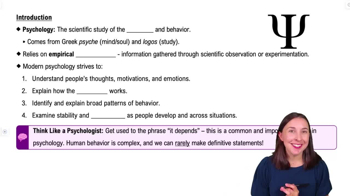
    Psychology studies behavior and mental processes, including both observable actions and internal experiences.
  • What is the main method used by structuralism?

    Structuralism primarily used introspection to analyze the basic elements of conscious experience.
  • What question does functionalism focus on?

    Functionalism asks: What is the function or adaptive purpose of mental processes and behavior? It emphasizes behavior's role in adaptation.
  • How do behaviorists view the mind?

    Behaviorists treat the mind as a black box, focusing only on observable stimulus-response relationships.
  • What is the main focus of cognitivism?

    Cognitivism centers on mental processes like perception, attention, memory, language, and problem solving.
  • Define bottom-up vs top-down processing in perception.

    Bottom-up: processing starts from sensory data to interpretation.
    Top-down: processing guided by knowledge, expectations, and experience.
  • What are the Gestalt principles of perceptual organization?

    Key laws include proximity, similarity, closure, good continuation, symmetry, good form, and common fate.
  • What is the difference between sensation and perception?

    Sensation is the reception of stimuli by sensory organs.
    Perception is the organization and interpretation of sensory information.
  • Explain classical conditioning (Pavlov).

    A neutral stimulus (CS) is paired with an unconditioned stimulus (US) to elicit a conditioned response (CR) after repeated associations.
  • What is operant conditioning (Thorndike, Skinner)?

    Behavior is shaped by consequences: reinforcement increases behavior; punishment decreases it.
  • Differentiate positive and negative reinforcement.

    Positive reinforcement: adding a pleasant stimulus to increase behavior.
    Negative reinforcement: removing an unpleasant stimulus to increase behavior.
  • What is selective attention?

    The process of focusing on relevant stimuli while ignoring others, due to limited cognitive resources.
  • Describe the cocktail party effect.

    The ability to focus auditory attention on a single conversation in a noisy environment, ignoring other stimuli.
  • What is inattentional blindness?

    Failure to notice a visible but unexpected object because attention is focused elsewhere.
  • What are the main stages of memory according to Atkinson-Shiffrin model?

    Memory stages: sensory memory, short-term memory, and long-term memory.
  • What is the difference between episodic and semantic memory?

    Episodic memory: personal events.
    Semantic memory: general knowledge and facts.
  • Define primacy and recency effects in memory recall.

    Primacy effect: better recall of items at the beginning of a list.
    Recency effect: better recall of items at the end.
  • What is the Big Five personality model?

    Five broad traits: Extraversion, Agreeableness, Conscientiousness, Neuroticism (emotional stability), and Openness to experience.
  • What is Bandura's concept of reciprocal determinism?

    Behavior, personal factors, and environment interact and influence each other continuously.
  • What is the difference between validity and reliability in psychological testing?

    Validity: the test measures what it is supposed to measure.
    Reliability: the test produces consistent and stable results.