 Indietro
Introduction to Psychology - Key Concepts and Theories
 01:11
01:11
Termini in questo insieme (31)
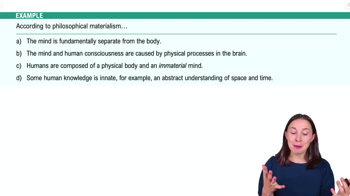
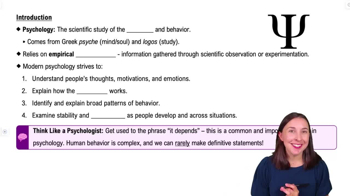
Psychology is the scientific study of behavior and mental processes.
Known as the father of psychology, he established the first psychology laboratory in 1879 and founded Structuralism, focusing on breaking down mental processes into basic components.
Developed by Sigmund Freud, it emphasizes the role of unconscious conflicts, childhood experiences, and internal drives in shaping behavior.
Focuses on how genes, brain structures, and neurotransmitters influence behavior.
Emphasizes human growth, potential, and self-actualization, with key figures like Maslow and Rogers.
Studies how we encode, process, store, and retrieve information, including thinking, memory, and problem-solving.
Examines how social and cultural environments influence behavior.
Focuses on how we learn from observable stimuli and responses through conditioning.
Explains behavior as a result of natural selection favoring traits that enhance survival and reproduction.
Basic research increases scientific knowledge; applied research solves practical problems.
1. Question and Literature Review
2. Testable Hypothesis
3. Research Design
4. Data Collection and Analysis
5. Publication
6. Theory Development
A tentative, testable prediction about the relationship between variables.
Repeating a study to confirm if the same results are obtained, ensuring reliability.
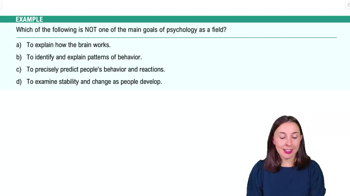
1. Description
2. Explanation
3. Prediction
4. Change
An ethical requirement that participants are informed about the study and voluntarily agree to participate.
Includes case studies, naturalistic observation, and surveys/interviews to describe behavior.
A measure of the relationship between two variables: positive, negative, or zero correlation.
Independent Variable (IV) is manipulated; Dependent Variable (DV) is measured as the outcome.
Experimental group receives treatment; control group does not, serving as a baseline.
Neither participants nor experimenters know group assignments, preventing bias.
The basic building block of the nervous system; transmits electrical impulses.
Dendrites receive messages, cell body sustains the neuron, axon sends impulses, myelin sheath insulates and speeds transmission.
A brief electrical charge traveling down an axon; an all-or-none response.
Consists of the brain and spinal cord; acts as the body's decision-maker.
Sympathetic activates 'fight or flight'; parasympathetic promotes 'rest and digest'.
Frontal: planning and personality
Parietal: sensory processing
Occipital: vision
Temporal: hearing and memory
1. Alarm: body prepares to fight or flee
2. Resistance: body adapts to stress
3. Exhaustion: resources depleted, risk of illness
Our awareness of ourselves and our environment.
Biological cycles on a 24-hour schedule, such as the sleep-wake cycle.
NREM 1: light sleep
NREM 2: sleep spindles
NREM 3: deep sleep
REM: dreaming, brain active but body paralyzed
Chemicals that alter perception and mood.