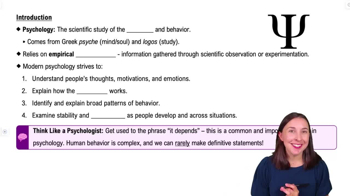
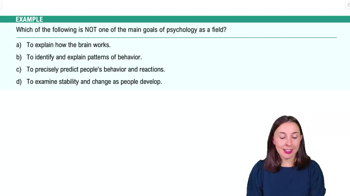
What are the three types of psychological research?
Descriptive: describes characteristics of a population; Correlation: determines relationships between two variables; Experiment: uses experimental and control groups to test hypotheses.
What is a positive relationship in correlation research?
Both variables move in the same direction.
What is a negative relationship in correlation research?
One variable moves in one direction while the other moves in the opposite direction.
What is random assignment in experimental research?
A procedure where participants are assigned to groups entirely by chance to reduce bias.
What is the double-blind procedure?
An experimental method where neither participants nor researchers know who is in the experimental or control group.
What is the placebo effect?
Changes in participants caused by expectations rather than the experimental treatment.
List the steps of psychology's scientific method.
1. Question 2. Literature Review 3. Hypothesis 4. Data Collection 5. Analyzing Data and Drawing Conclusions.
What is the nervous system?
The full set of nerves connecting the brain with all other parts of the body.
What are neurons?
Cells that facilitate communication within the nervous system.
What role do glial cells play in the nervous system?
They provide support, protection, nutrition, and myelin for neurons.
What do sensory neurons do?
Carry information from the senses (sight, hearing, smell, taste, touch) to the brain.
What do motor neurons do?
Carry messages from the brain to muscles to produce movement.
What is biopsychology?
The study of the biological basis of behavior, including genetics, brain function, hormones, and brain structures.
What is the nature vs. nurture debate?
Nature refers to genetics; nurture refers to environmental influences on behavior and traits.
What does epigenetics study?
How environmental factors can affect gene expression without changing the DNA sequence.
 Indietro
 01:11
01:11