 Indietro
Introduction to Psychology: Psychological Research and the Scientific Method
 03:03
03:03
Termini in questo insieme (25)
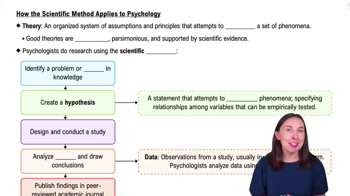
The scientific method is a systematic approach psychologists use to acquire knowledge and understand behavior and phenomena.
Theories provide broad explanations and predictions about observations, offering a framework to understand relationships among facts.
A hypothesis is a testable prediction derived from a theory, stated so it can be empirically tested.
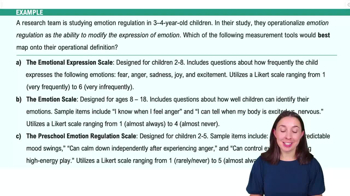
An operational definition translates a hypothesis into specific, measurable procedures for observation and testing.
To organize observations, place data in a coherent framework, make deductions about unexplained phenomena, and develop ideas for future research.
Archival research examines existing data like census or college records to test hypotheses; it is inexpensive but may have incomplete data.
Naturalistic observation involves observing behavior in its natural environment without interference, providing authentic data but lacking control.
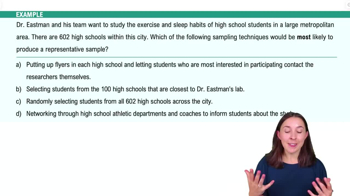
Advantage: can infer attitudes of a larger group if sample is representative. Disadvantages: unrepresentative samples and untruthful or unaware respondents.
A case study is an in-depth investigation of an individual or small group, offering insights but limited generalizability.
Correlational research examines relationships between variables to see if they are associated but cannot establish cause and effect.
A positive correlation means as one variable increases, the other also increases; values range closer to +1.0 for stronger associations.
A negative correlation means as one variable increases, the other decreases; values closer to −1.0 indicate stronger negative associations.
An experiment manipulates one variable to observe effects on another, allowing cause-and-effect conclusions.
The experimental group receives the treatment; the control group does not, allowing comparison to isolate treatment effects.
The independent variable is manipulated; the dependent variable is measured and expected to change due to manipulation.
Random assignment assigns participants to groups by chance, controlling for participant differences across conditions.
The theory that as the number of bystanders increases, each feels less personal responsibility to help, reducing intervention likelihood.
A significant outcome means research findings are statistically meaningful, supporting confirmation of hypotheses.
Replication is repeating studies with different methods or groups to increase confidence in findings.
Protection from harm, privacy rights, voluntary participation, informed consent, and independent review of experiments.
Informed consent is a signed document where participants acknowledge understanding the study and their involvement.
Debriefing explains the study and procedures to participants after their involvement, clarifying any deception used.
Allows questions and controls not possible with humans, but requires minimizing animal discomfort and justifying distress ethically.
Experimental bias occurs when experimenter or participant expectations unintentionally influence results.
A placebo is a false treatment; a double-blind procedure keeps both experimenter and participant unaware of treatment to avoid bias.