Skip to main content
Introduction to Psychology
Il mio corso
Impara
Preparazione agli esami
AI Tutor
Guide di studio
Flashcard
Esplora
Prova l'app
Il mio corso
Impara
Preparazione agli esami
AI Tutor
Guide di studio
Flashcard
Esplora
Prova l'app
Indietro
Introduction to Psychology: The Scientific Attitude and Foundations
Puoi toccare per girare la carta.
What is psychology's approach to understanding behavior?
Puoi toccare per girare la carta.
👆
What is psychology's approach to understanding behavior?
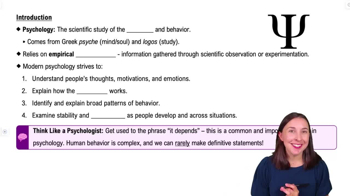
Psychology
employs an
empirical approach
to explore and understand behavior without being misled.
Avanzamenti del tracciato
I pulsanti di controllo sono stati cambiati in modalità "navigazione".
1/22
Video consigliati
VideoThumbView.guidedCourse
01:11
What is Psychology? Example 2
2917
views
82
rank
VideoThumbView.guidedCourse
05:43
What is Psychology?
6148
views
201
rank
VideoThumbView.guidedCourse
01:29
What is Psychology? Example 1
3625
views
128
rank
Termini in questo insieme (22)
Nascondere definizioni
What is psychology's approach to understanding behavior?
Psychology
employs an
empirical approach
to explore and understand behavior without being misled.
What three qualities define the scientific attitude in psychology?
Curiosity
,
skepticism
, and
humility
are essential for scientific inquiry in psychology.
How does curiosity support scientific inquiry?
Curiosity drives the desire to ask questions and explore new ideas to better understand behavior.
What role does skepticism play in scientific thinking?
Skepticism involves questioning claims and requiring evidence before accepting conclusions.
Why is humility important in psychology?
Humility allows scientists to accept when they are wrong and remain open to new evidence.
What is critical thinking in psychology?
Critical thinking examines assumptions, appraises sources, discerns biases, evaluates evidence, and assesses conclusions.
Who established psychology's first laboratory and what was its focus?
Wilhelm Wundt established the first lab to measure the 'atoms of the mind' through experimental methods.
What is structuralism and who founded it?
Structuralism, founded by Titchener, used introspection to explore the structure of the mind.
What is functionalism and who influenced it?
Functionalism, influenced by William James and Darwin, focused on the adaptive functions of consciousness.
Who were the first prominent women in psychology?
Whiton Calkins was a pioneering memory researcher and first female APA president; Floy Washburn was the first woman to earn a Ph.D. in psychology.
What major psychological force emerged in the 1920s-1960s focusing on observable behavior?
Behaviorism
emphasized scientific study of observable behavior, conditioning, and learning.
What did Freudian psychology emphasize?
Freudian psychology emphasized the unconscious mind and childhood experiences shaping behavior.
What is humanistic psychology's main focus?
Humanistic psychology emphasizes human growth potential, love, acceptance, and nurturing environments.
What is cognitive psychology?
Cognitive psychology studies mental processes like perception, learning, memory, thinking, and problem-solving.
What does evolutionary psychology study?
Evolutionary psychology studies behavior and mind evolution using natural selection principles.
What is the nature–nurture issue in psychology?
It questions whether traits are innate (nature) or developed through experience (nurture).
What is behavior genetics?
Behavior genetics studies the relative influence of genes and environment on behavior.
How does culture influence psychology?
Culture shapes shared ideas and behaviors passed across generations, influencing behavior.
What is gender identity in psychology?
Gender identity is a person's sense of being male, female, neither, or a combination, shaped socially and biologically.
What is positive psychology?
Positive psychology studies happiness and human flourishing using scientific methods.
What three levels does the biopsychosocial approach integrate?
It integrates
biological
,
psychological
, and
social-cultural
levels of analysis.
What are the main subfields of psychology?
Subfields include basic research, applied research, counseling, clinical psychology, psychiatry, and community psychology.
 IndietroIndietro
 01:11
01:11