Skip to main content
Introduction to Sociology
Il mio corso
Impara
AI Tutor
Guide di studio
Flashcard
Esplora
Prova l'app
Il mio corso
Impara
AI Tutor
Guide di studio
Flashcard
Esplora
Prova l'app
Indietro
Ethnocentrism vs. Cultural Relativism quiz
Puoi toccare per girare la carta.
What is ethnocentrism in sociology?
Puoi toccare per girare la carta.
👆
What is ethnocentrism in sociology?
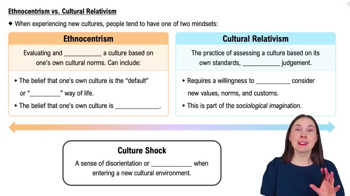
Ethnocentrism is evaluating and judging another culture based on your own cultural norms, often believing your culture is superior.
Avanzamenti del tracciato
I pulsanti di controllo sono stati cambiati in modalità "navigazione".
1/15
Flashcard correlate
Video consigliati
Ethnocentrism vs. Cultural Relativism definitions
Ethnocentrism vs. Cultural Relativism
15 Termini
VideoThumbView.guidedCourse
01:28
Ethnocentrism vs. Cultural Relativism Example 1
162
views
1
rank
VideoThumbView.guidedCourse
03:16
Ethnocentrism vs. Cultural Relativism
186
views
4
rank
Termini in questo insieme (15)
Nascondere definizioni
What is ethnocentrism in sociology?
Ethnocentrism is evaluating and judging another culture based on your own cultural norms, often believing your culture is superior.
How does cultural relativism differ from ethnocentrism?
Cultural relativism involves assessing a culture by its own standards without judgment, rather than using your own culture as a reference.
What does it mean to view your culture as the 'default'?
It means believing your own culture is the normal or standard way of life, which is a component of ethnocentrism.
Why is cultural relativism considered more effortful than ethnocentrism?
Because it requires putting aside your own beliefs and neutrally considering unfamiliar values and customs.
Does practicing cultural relativism mean abandoning your own morals?
No, it means temporarily setting aside your beliefs to assess another culture nonjudgmentally, not giving up your values.
What is culture shock?
Culture shock is the sense of disorientation or discomfort experienced when entering a new cultural environment.
How might an ethnocentric person respond to culture shock?
They may feel disgust or discomfort and be more likely to withdraw to a familiar culture.
How might a person with a relativist mindset respond to culture shock?
They may approach their discomfort with curiosity and try to learn more about the new culture.
Is culture shock an abnormal reaction to new cultures?
No, culture shock is a very normal experience when entering a new cultural environment.
Where do most people fall on the spectrum between ethnocentrism and cultural relativism?
Most people are somewhere in the middle, not purely ethnocentric or purely relativist.
What sociological concept helps with practicing cultural relativism?
The sociological imagination, which involves putting your own attitudes and beliefs on hold to evaluate another culture.
What is the main risk of an ethnocentric mindset when encountering new cultures?
It can lead to negative judgments and a lack of understanding of other cultures.
What is the benefit of cultural relativism for understanding other societies?
It fosters greater understanding and appreciation of cultural differences.
How do mindsets influence the experience of culture shock?
Mindsets shape whether individuals respond to culture shock with withdrawal or curiosity and learning.
Why is recognizing ethnocentrism and cultural relativism important in sociology?
It enhances comprehension of cultural integration, socialization, and the dynamics of cultural universals and norms.
 IndietroIndietro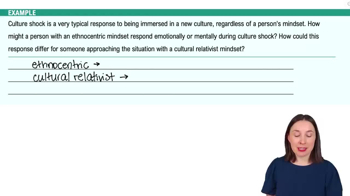
 01:28
01:28