Who is Auguste Comte and his contribution to sociology?
Auguste Comte coined the term sociology and pioneered studying society from a scientific perspective during rapid social change in the 1780-1850s.
How is sociology defined?
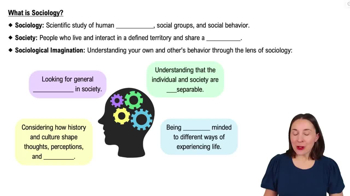
Sociology is the systematic study of human society, focusing on social interactions, patterns, and shared understandings within groups.
What defines a society?
A society is a human group sharing a common geographic territory and institutions, requiring social interactions that create shared patterns and expectations.
What is culture in sociology?
Culture is a system of behaviors, beliefs, practices, knowledge, and values that shape societal interactions.
What are dominant culture, counterculture, and subculture?
Dominant culture is the majority culture with political/economic power; counterculture opposes dominant culture; subculture shares traits but also differs in some practices.
What is the sociological imagination?
The ability to see the connection between personal troubles and public issues, understanding how individual choices are shaped by social structures.
What are the three core foci of sociology?
1. Social inequality 2. Social institutions 3. Social change
What is social inequality in sociology?
Social inequality refers to the gap between advantaged and disadvantaged groups based on class, gender, race, and ethnicity.
What are the five core social institutions?
Family, Education, Religion, Economy, and Government.
What is secularization in social change?
Secularization is the decline of religious influence and power in society, often linked to modernization.
What are social facts according to Durkheim?
Social facts are societal norms and values that shape individual behavior and exist outside individual control.
What are the four types of suicide identified by Durkheim?
1. Egoistic 2. Altruistic 3. Anomic 4. Fatalistic, each linked to levels of social integration and regulation.
How does sociology differ from common sense?
Sociology moves beyond superficial observations by using systematic research to understand social patterns like homophily (similarity attraction).
What are the three classical sociological perspectives?
Structural functionalism, Conflict theory, and Symbolic interactionism.
What is structural functionalism?
A perspective viewing society as interconnected institutions working together to maintain social cohesion and stability.
What is conflict theory?
A perspective focusing on power struggles and conflicts between competing social groups, rooted in class differences.
What is symbolic interactionism?
A perspective emphasizing active socialization through interaction and negotiation of meanings between individuals.
Who are agents of socialization?
Groups or institutions like family, peers, media, education, and religion that guide individuals in learning societal norms.
What is the 'looking glass self' concept by Cooley?
Our self-concept develops based on how we think others perceive us.
What is the difference between primary and secondary socialization?
Primary socialization occurs in the family learning basic values; secondary socialization happens later learning behaviors for subcultures or new roles.
What is anticipatory socialization?
Rehearsing or preparing for future roles before fully entering them.
What is resocialization?
The process of discarding old roles and adopting new ones, either voluntarily or involuntarily.
What is deviance in sociology?
Deviance is behavior that violates social norms, ranging from minor acts like tattoos to serious crimes.
What is the social construction theory of deviance?
Deviance is created and maintained through social interactions and shared definitions.
What is strain theory in explaining deviance?
Deviance occurs when individuals lack legitimate opportunities to achieve societal goals.
What is labeling theory?
Deviance results from society labeling individuals, leading to a self-fulfilling prophecy.
How do crime rates vary by age, gender, and race in the U.S.?
Crime rates peak between ages 25-29; men have higher arrest rates than women; racial disparities exist due to economic and policing factors.
 Indietro
 00:35
00:35