Skip to main content
Introductory Statistics
Il mio corso
Impara
Preparazione agli esami
AI Tutor
Guide di studio
Soluzioni per libri di testo
Flashcard
Esplora
Prova l'app
Il mio corso
Impara
Preparazione agli esami
AI Tutor
Guide di studio
Soluzioni per libri di testo
Flashcard
Esplora
Prova l'app
Indietro
Complements definitions
Puoi toccare per girare la carta.
Complement
Puoi toccare per girare la carta.
👆
Complement
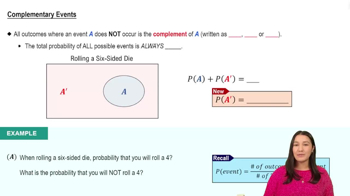
All possible outcomes where a specific event does not occur, forming a set opposite to the event within the sample space.
Avanzamenti del tracciato
I pulsanti di controllo sono stati cambiati in modalità "navigazione".
1/15
Flashcard correlate
Pratica correlata
Video consigliati
Complements quiz
Complements
15 Termini
Complements
4. Probability
4 Problemi
Argomento
Ernest
Addition Rule
4. Probability
6 Problemi
Argomento
Ernest
4. Probability - Part 1 of 3
3 Argomenti
9 Problemi
Capitolo
Ernest
4. Probability - Part 2 of 3
4 Argomenti
12 Problemi
Capitolo
Ernest
4. Probability - Part 3 of 3
2 Argomenti
6 Problemi
Capitolo
Ally
VideoThumbView.guidedCourse
4:23
Complementary Events
6833
views
199
rank
Termini in questo insieme (15)
Nascondere definizioni
Complement
All possible outcomes where a specific event does not occur, forming a set opposite to the event within the sample space.
Event
A specific outcome or group of outcomes of a random experiment, such as rolling a particular number on a die.
Probability
A numerical measure representing the likelihood of an event, calculated as favorable outcomes divided by total possible outcomes.
Sample Space
The complete set of all possible outcomes for a random experiment, such as all sides of a die.
Notation
Symbols or marks used to represent events and their complements, including apostrophes, bars, or special signs.
Formula
A mathematical expression used to calculate probabilities, such as subtracting an event's probability from one for its complement.
Classical Probability
A principle stating that the sum of probabilities for all possible outcomes equals one, ensuring completeness.
Outcome
A single possible result from a random experiment, like drawing a specific card or rolling a certain number.
Deck
A collection of 52 cards used in probability examples, each card representing a unique outcome.
Queen
A specific card in a deck, often used as an example event in probability calculations.
Decimal
A numerical representation of probability, such as 0.92, used for easier interpretation of results.
Total Outcomes
The count of all possible results in an experiment, forming the denominator in probability calculations.
Favorable Outcomes
The number of results that satisfy the event of interest, forming the numerator in probability calculations.
Non-occurrence
The situation where a specific event does not happen, represented by its complement in probability.
Random Experiment
A process with uncertain results, such as rolling dice or drawing cards, forming the basis for probability analysis.
 IndietroIndietro

 4:23
4:23