Skip to main content
Introductory Statistics
Il mio corso
Impara
Preparazione agli esami
AI Tutor
Guide di studio
Soluzioni per libri di testo
Flashcard
Esplora
Prova l'app
Il mio corso
Impara
Preparazione agli esami
AI Tutor
Guide di studio
Soluzioni per libri di testo
Flashcard
Esplora
Prova l'app
Indietro
Goodness of FIt Test Using TI-84 quiz
Puoi toccare per girare la carta.
What is the purpose of a goodness-of-fit test?
Puoi toccare per girare la carta.
👆
What is the purpose of a goodness-of-fit test?
A goodness-of-fit test compares observed frequencies to expected frequencies to determine if data fits a claimed distribution.
Avanzamenti del tracciato
I pulsanti di controllo sono stati cambiati in modalità "navigazione".
1/15
Flashcard correlate
Pratica correlata
Video consigliati
Goodness of FIt Test Using TI-84 definitions
Goodness of FIt Test Using TI-84
15 Termini
13. Chi-Square Tests & Goodness of Fit
4 Argomenti
5 Problemi
Capitolo
VideoThumbView.guidedCourse
03:55
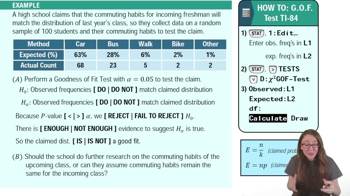
Goodness of Fit Test Using a TI-84 Example 2
211
views
2
rank
VideoThumbView.guidedCourse
02:50
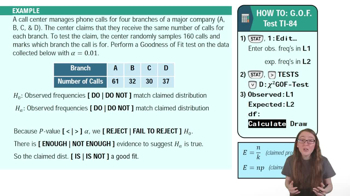
Goodness of Fit Test Using a TI-84 Example 1
200
views
2
rank
VideoThumbView.guidedCourse
03:25
Goodness of Fit Test Using a TI-84 Example 3
195
views
5
rank
Termini in questo insieme (15)
Nascondere definizioni
What is the purpose of a goodness-of-fit test?
A goodness-of-fit test compares observed frequencies to expected frequencies to determine if data fits a claimed distribution.
How do you calculate expected values for equally distributed categories?
Expected values are calculated as e = n / k, where n is the sample size and k is the number of categories.
What is the formula for degrees of freedom in a goodness-of-fit test?
Degrees of freedom are calculated as k - 1, where k is the number of categories.
Where do you enter observed frequencies on the TI-84 for a GOF test?
Observed frequencies are entered in list L1 on the TI-84.
Where do you enter expected values on the TI-84 for a GOF test?
Expected values are entered in list L2 on the TI-84.
Which menu option on the TI-84 is used for the chi-square goodness-of-fit test?
Option D, the chi-square GOF test function, is used for the goodness-of-fit test.
What should you check in the TI-84 menu before running the GOF test?
Ensure observed is set to L1, expected is set to L2, and degrees of freedom match your problem.
What statistic does the TI-84 provide after running the GOF test?
The TI-84 provides the chi-square statistic, p-value, degrees of freedom, and contribution values.
What is the significance level (alpha) commonly used in hypothesis testing?
A common significance level is 0.05, or 5%.
How do you interpret a p-value greater than alpha in a GOF test?
If the p-value is greater than alpha, you fail to reject the null hypothesis, indicating the data fits the claimed distribution.
What does it mean to fail to reject the null hypothesis in a GOF test?
It means there is not enough evidence to conclude the observed frequencies do not match the claim distribution.
What is the null hypothesis in a goodness-of-fit test?
The null hypothesis states that observed frequencies match the claimed distribution.
What is the alternative hypothesis in a goodness-of-fit test?
The alternative hypothesis states that observed frequencies do not match the claimed distribution.
What are contribution values in the TI-84 GOF test output?
Contribution values show what each observed frequency contributes to the chi-square statistic.
What conclusion can you draw if flavor preferences are evenly distributed among categories?
If flavor preferences are evenly distributed, the claim distribution is a good fit for the observed data.
 IndietroIndietro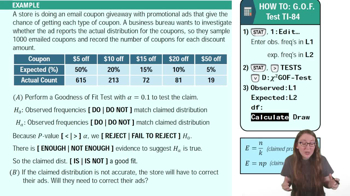
 03:55
03:55