Skip to main content
Introductory Statistics
Il mio corso
Impara
Preparazione agli esami
AI Tutor
Guide di studio
Soluzioni per libri di testo
Flashcard
Esplora
Prova l'app
Il mio corso
Impara
Preparazione agli esami
AI Tutor
Guide di studio
Soluzioni per libri di testo
Flashcard
Esplora
Prova l'app
Indietro
Performing Hypothesis Tests: Proportions quiz
Puoi toccare per girare la carta.
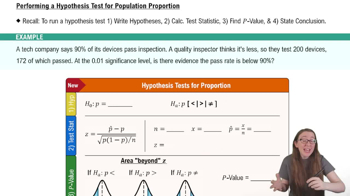
What are the four main steps in performing a hypothesis test for a population proportion?
Puoi toccare per girare la carta.
👆
What are the four main steps in performing a hypothesis test for a population proportion?
The four steps are: write the hypotheses, calculate the test statistic, find the p-value, and state the conclusion.
Avanzamenti del tracciato
I pulsanti di controllo sono stati cambiati in modalità "navigazione".
1/15
Flashcard correlate
Pratica correlata
Video consigliati
Performing Hypothesis Tests: Proportions definitions
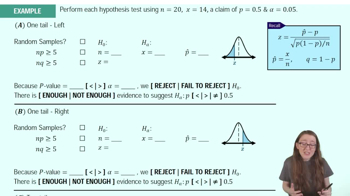
Performing Hypothesis Tests: Proportions
15 Termini
Performing Hypothesis Tests: Proportions
9. Hypothesis Testing for One Sample
5 Problemi
Argomento
Ernest
9. Hypothesis Testing for One Sample - Part 1 of 2
5 Argomenti
14 Problemi
Capitolo
David-Paige
9. Hypothesis Testing for One Sample - Part 2 of 2
1 Argomento
3 Problemi
Capitolo
Justin
VideoThumbView.guidedCourse
05:52
Performing Hypothesis Tests: Proportions
1132
views
15
rank
VideoThumbView.guidedCourse
07:06
Performing Hypothesis Tests: Proportions Example 1
763
views
13
rank
VideoThumbView.guidedCourse
03:32
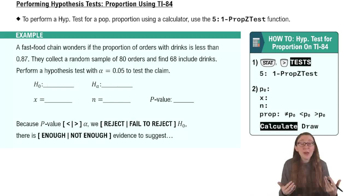
Performing Hypothesis Tests: Proportions Using TI-84
395
views
4
rank
Termini in questo insieme (15)
Nascondere definizioni
What are the four main steps in performing a hypothesis test for a population proportion?
The four steps are: write the hypotheses, calculate the test statistic, find the p-value, and state the conclusion.
In hypothesis testing, what does the null hypothesis (H0) typically state about the population proportion?
The null hypothesis states that the population proportion is equal to the expected value.
How do you calculate the sample proportion (p̂) in a hypothesis test?
Divide the number of successes (x) by the sample size (n).
What formula is used to calculate the z-score for a population proportion hypothesis test?
The z-score is (p̂ - p) divided by the square root of [p(1-p)/n].
What does the p-value represent in a hypothesis test?
The p-value is the probability of obtaining a test statistic as extreme as, or more extreme than, the observed value under the null hypothesis.
How do you determine if a hypothesis test is left-tailed, right-tailed, or two-tailed?
Look at the alternative hypothesis: '<' means left-tailed, '>' means right-tailed, and '≠' means two-tailed.
What is the significance level (alpha, α) in hypothesis testing?
Alpha is the threshold probability for rejecting the null hypothesis, commonly set at 0.05 or 0.01.
What decision do you make if the p-value is greater than alpha?
You fail to reject the null hypothesis.
What are the two conditions involving n, p, and q that must be checked before performing a hypothesis test for a proportion?
Both n*p and n*q must be at least 5.
What does it mean to 'fail to reject the null hypothesis' in the context of a population proportion?
It means there is not enough evidence to support the alternative hypothesis about the population proportion.
Why is it important to check if the sample was randomly selected in hypothesis testing?
Random sampling ensures the validity of the test results and that the sample represents the population.
On a TI-84 calculator, which function is used to perform a hypothesis test for a population proportion?
Use the '1-PropZTest' function.
What values must you input into the calculator to perform a 1-PropZTest?
You need the expected population proportion (p0), the number of successes (x), and the sample size (n).
If the alternative hypothesis is p < p0, which type of test are you performing?
You are performing a left-tailed test.
What conclusion do you draw if the p-value is less than alpha in a hypothesis test for a proportion?
You reject the null hypothesis, indicating sufficient evidence for the alternative hypothesis.
 IndietroIndietro

 05:52
05:52