Skip to main content
Introductory Statistics
Il mio corso
Impara
Preparazione agli esami
AI Tutor
Guide di studio
Soluzioni per libri di testo
Flashcard
Esplora
Prova l'app
Il mio corso
Impara
Preparazione agli esami
AI Tutor
Guide di studio
Soluzioni per libri di testo
Flashcard
Esplora
Prova l'app
Indietro
Two Proportions definitions
Puoi toccare per girare la carta.
Null Hypothesis
Puoi toccare per girare la carta.
👆
Null Hypothesis
Default assumption that two population proportions are equal, forming the basis for statistical comparison.
Avanzamenti del tracciato
I pulsanti di controllo sono stati cambiati in modalità "navigazione".
1/15
Flashcard correlate
Pratica correlata
Video consigliati
Two Proportions quiz #1
Two Proportions
10 Termini
Two Proportions
10. Hypothesis Testing for Two Samples
3 Problemi
Argomento
Zachary
10. Hypothesis Testing for Two Samples - Part 1 of 2
5 Argomenti
12 Problemi
Capitolo
Brendan
10. Hypothesis Testing for Two Samples - Part 2 of 2
1 Argomento
2 Problemi
Capitolo
Ernest
VideoThumbView.guidedCourse
08:09
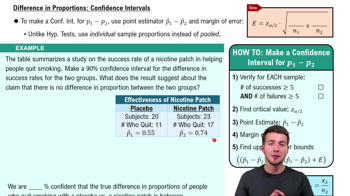
Difference in Proportions: Confidence Intervals
966
views
16
rank
VideoThumbView.guidedCourse
05:32
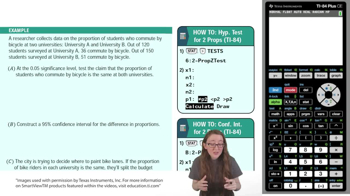
Two Proportions Inferences Using a TI-84 Example 3
411
views
VideoThumbView.guidedCourse
10:28
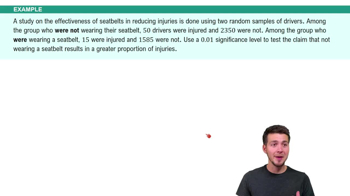
Difference in Proportions: Hypothesis Tests Example 1
888
views
14
rank
Termini in questo insieme (15)
Nascondere definizioni
Null Hypothesis
Default assumption that two population proportions are equal, forming the basis for statistical comparison.
Alternative Hypothesis
Statement suggesting a difference exists between two population proportions, guiding the direction of the test.
Z Score
Standardized value used to measure the difference between sample proportions relative to expected variation.
P Value
Probability of observing a result as extreme as the sample, used to determine statistical significance.
Alpha
Threshold for statistical significance, often set at 0.05, used to decide whether to reject the null hypothesis.
Confidence Interval
Range estimating the difference between two population proportions, indicating the level of certainty in the result.
Point Estimate
Best guess for the difference between two sample proportions, forming the center of the confidence interval.
Margin of Error
Amount added and subtracted from the point estimate to create the confidence interval, reflecting sampling variability.
Pooled Proportion
Weighted average of successes across both samples, used in hypothesis testing to calculate expected variation.
Critical Value
Z score corresponding to the chosen confidence level, determining the width of the confidence interval.
Sample Proportion
Ratio of successes to total observations in a sample, used to estimate population proportions.
Complement
Value representing the proportion of failures, calculated as one minus the sample proportion.
Two-Tailed Test
Statistical test considering differences in both directions, used when the alternative hypothesis is not equal.
Independence
Condition ensuring that samples do not influence each other, required for valid hypothesis testing.
Normality Condition
Requirement that each sample has at least five successes and failures, allowing use of normal approximation.
 IndietroIndietro


 08:09
08:09