Skip to main content
Introductory Statistics
Il mio corso
Impara
Preparazione agli esami
AI Tutor
Guide di studio
Soluzioni per libri di testo
Flashcard
Esplora
Prova l'app
Il mio corso
Impara
Preparazione agli esami
AI Tutor
Guide di studio
Soluzioni per libri di testo
Flashcard
Esplora
Prova l'app
Indietro
Two-Way ANOVA quiz
Puoi toccare per girare la carta.
What does two-way ANOVA analyze?
Puoi toccare per girare la carta.
👆
What does two-way ANOVA analyze?
Two-way ANOVA analyzes the effects of two factors on a dependent variable and tests for interaction effects between those factors.
Avanzamenti del tracciato
I pulsanti di controllo sono stati cambiati in modalità "navigazione".
1/15
Flashcard correlate
Pratica correlata
Video consigliati
Two-Way ANOVA definitions
Two-Way ANOVA
15 Termini
Two-Way ANOVA
14. ANOVA
5 Problemi
Argomento
Justin
14. ANOVA - Part 1 of 2
4 Argomenti
12 Problemi
Capitolo
Ally
14. ANOVA - Part 2 of 2
1 Argomento
3 Problemi
Capitolo
Justin
VideoThumbView.guidedCourse
08:17
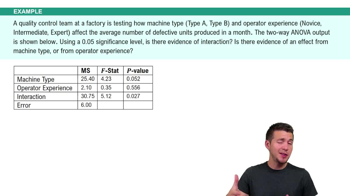
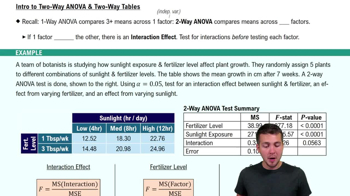
Intro to Two-Way ANOVA & Two-Way Tables
315
views
VideoThumbView.guidedCourse
05:00
Intro to Two-Way ANOVA & Two-Way Tables Example 1
192
views
2
rank
VideoThumbView.guidedCourse
06:35
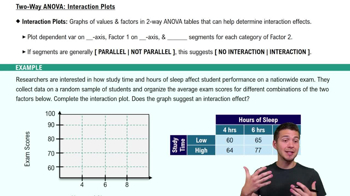
Two-Way ANOVA: Interaction Plots
191
views
2
rank
Termini in questo insieme (15)
Nascondere definizioni
What does two-way ANOVA analyze?
Two-way ANOVA analyzes the effects of two factors on a dependent variable and tests for interaction effects between those factors.
How is a two-way ANOVA different from a one-way ANOVA?
Two-way ANOVA compares means across two factors, while one-way ANOVA compares means across only one factor.
What is an interaction effect in two-way ANOVA?
An interaction effect occurs when the impact of one factor on the dependent variable depends on the level of the other factor.
What is the first step when analyzing a two-way ANOVA problem?
The first step is to test for interaction effects between the two factors before testing the effects of each factor individually.
What are the null and alternative hypotheses for testing interaction effects?
The null hypothesis states there is no interaction effect, while the alternative hypothesis states there is an interaction effect.
How is the F statistic calculated in two-way ANOVA?
The F statistic is calculated as the ratio of mean squares for the factor or interaction to the mean square error (MSE).
What does a p-value greater than the significance level indicate in two-way ANOVA?
A p-value greater than the significance level means you fail to reject the null hypothesis, indicating no significant effect.
What should you do if there is no interaction effect in two-way ANOVA?
If there is no interaction effect, you can proceed to test the individual effects of each factor on the dependent variable.
What happens if a significant interaction effect is found?
If a significant interaction effect is found, you cannot reliably test the individual effects of each factor because they interfere with each other.
How are hypotheses for individual factors set up in two-way ANOVA?
The null hypothesis states there is no difference in means for the factor, while the alternative hypothesis states there is a difference.
What does rejecting the null hypothesis for a factor in two-way ANOVA mean?
Rejecting the null hypothesis means there is evidence that the factor has a significant effect on the dependent variable.
What is an interaction plot used for in two-way ANOVA?
An interaction plot visually assesses whether there is an interaction effect by comparing the parallelism of lines representing factor levels.
How do you interpret parallel lines in an interaction plot?
Parallel lines suggest there is no interaction effect between the factors.
What does it mean if lines in an interaction plot are not parallel?
Non-parallel lines indicate an interaction effect, meaning the effect of one factor depends on the level of the other.
Which axes are used for factors and the dependent variable in an interaction plot?
The dependent variable is plotted on the y-axis, one factor is on the x-axis, and the other factor is represented by different lines.
 IndietroIndietro
 08:17
08:17