 Indietro
Chap 1
 04:24
04:24

Termini in questo insieme (18)
· a collection of methods for planning studies and experiments, obtaining data, and then organizing, summarizing, presenting, analyzing, interpreting, and drawing conclusions based on the data
Statistics
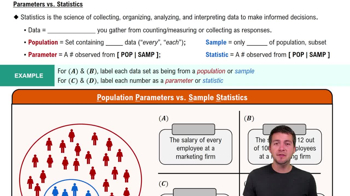
a complete collection of all elements to be studied.
Population
a collection of data from every member of the population
Census
Subcollection of members selected from a population. The objective is to use the sample data as a basis for drawing a conclusion about he whole population
Sample
a numerical measurement describing some characteristic of a populatin
Parameter
a numerical measurement describing some characteristic of a sample
Statistic
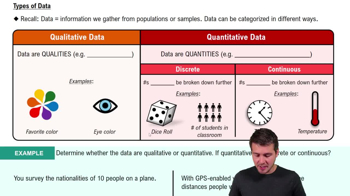
numbers representing counts or measurements
Quantitative data
can be separated into different categories that are distinguished by some non-numeric characteristic
Qualitative data
result when the number of possible values is either a finite number or a countable number
Discrete Data
result from infinitely many possible values that correspond to some continuous scale that covers a range of values without gaps, interruptions or jumps
Continuous Data
the method used to collect sample data influences the quality of the statistical analysis
Collecting sample data
measures specific traits it does not modify subjects
Observation
applying a treatment and then measuring the effect on the subject.
Experiments
large enough to see the true nature of any effects and obtain that sample using an appropriate method, such as one based on randomness
Sample Size
Each member of a population has an equal chance of being selected in the sample
Random
each group of size N has an equal chance of being selected.
Simple Random Sample
use data that are very easy to get not random
Convenience Sampling
one in which the respondents themselves decide whether to be included.
Voluntary response sample or self-selected sample