 Indietro
Introductory Statistics: Classifying Variables and Data Collection
 06:52
06:52
Termini in questo insieme (20)
A variable is a characteristic of interest to be measured for individuals in a group (population), yielding data.
Data is the result when a variable is measured, either as qualitative (categorical) or quantitative (numerical) responses.
If the variable describes a category, it is qualitative. If it measures or counts a quantity, it is quantitative.
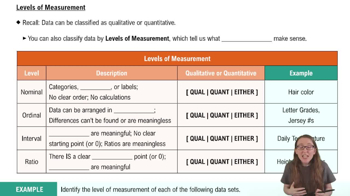
Nominal: categories with no natural order.
Ordinal: categories with a natural order.
Discrete: values are counted.
Continuous: values are measured.
A student's major or ZIP code, which are categories with no natural order.
A student's class year (first-year, sophomore, junior, senior) or course rating (poor, fair, good, excellent).
The number of courses a student is taking or the number of siblings a student has, which are counted values.
The number of hours a student slept or a student's height, which are measured values.
Does the variable describe a category or measure/count a quantity? If category → qualitative; if quantity → quantitative.
Check if categories have a natural order: no order → nominal; natural order → ordinal.
Check if values are counted or measured: counted → discrete; measured → continuous.
Quantitative and discrete, because it is a counted number.
Qualitative, because it is a categorical yes/no response.
Quantitative and continuous, because it is a measured amount.
Quantitative and discrete, because it is a counted number of students.
Qualitative, because it is a categorical variable with no natural order.
Because ZIP codes are labels without meaningful numerical order, making them qualitative nominal variables.
Discrete variables are counted values; continuous variables are measured values that can take any value in a range.
The main question or problem that guides what data to collect and analyze.