 Indietro
Introductory Statistics Key Concepts
 04:24
04:24

Termini in questo insieme (27)
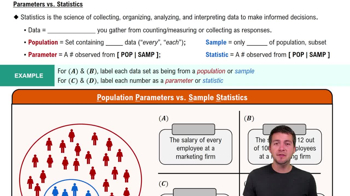
A parameter is a numerical value that describes a characteristic of a population.
A statistic is a numerical value that describes a characteristic of a sample.
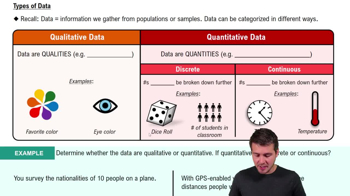
Quantitative data consists of numerical values that represent counts or measurements.
Categorical data (or qualitative data) represent categories or labels without numerical meaning.
A voluntary response sample is a sample where participants choose to respond, often leading to bias.
The population is the entire group of individuals or items of interest in a study.
A sample is a subset of the population selected for study.
A census collects data from every member of the population.
Discrete data can take on only specific values, often counts, with gaps between values.
Continuous data can take any value within an interval, often measurements.
Nominal data classify into categories without order or ranking.
Ordinal data classify into categories with a meaningful order but no consistent difference between ranks.
Interval data have ordered categories with meaningful differences but no true zero point.
Ratio data have ordered categories, meaningful differences, and a true zero point.
A simple random sample is a sample where every member of the population has an equal chance of selection.
Systematic sampling selects every kth individual from a list or sequence.
Convenience sampling selects individuals easiest to reach, often biased.
Stratified sampling divides the population into groups (strata) and samples from each group.
Cluster sampling divides the population into clusters, then randomly selects entire clusters.
An observational study observes subjects without manipulating variables.
An experiment applies treatments to subjects to observe effects.
A placebo is a fake treatment used to control for the placebo effect in experiments.
Sampling error is the difference between a sample statistic and the population parameter caused by random chance.
Nonresponse occurs when some selected individuals do not respond, potentially biasing results.
Data are missing completely at random if the missingness is unrelated to any data values.
A retrospective study looks backward in time, often using existing records.
A prospective study follows subjects forward in time to observe outcomes.