Ch. 3 - Probability
Larson - Elementary Statistics: Picturing the World 8th Edition
Larson8th EditionElementary Statistics: Picturing the WorldISBN: 9780137493470Non è quello che usi tu?Cambia libro di testo
Capitolo 3, Problema 3.3.26d

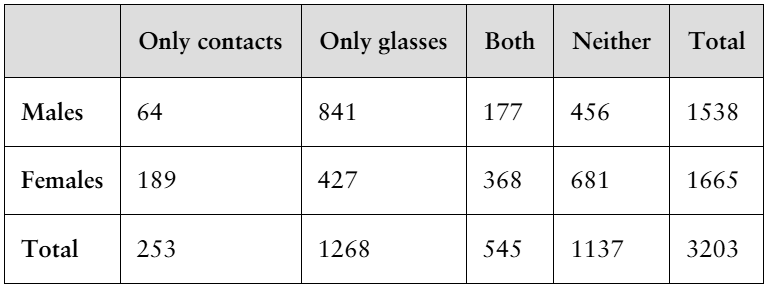
26. Eye Survey The table shows the results of a survey that asked 3203 people whether they wore contacts or glasses. A person is selected at random from the sample. Find the probability of each event.
d. The person is male or does not wear glasses.
<IMAGE>

Guida verificata passo dopo passo
1
Step 1: Understand the problem. We are tasked with finding the probability that a randomly selected person is either male or does not wear glasses. This involves using the addition rule for probabilities and analyzing the table provided.
Step 2: Identify the relevant groups. From the table, the total number of males is 1538, and the total number of people who do not wear glasses includes those who wear only contacts (253) and those who wear neither (1137).
Step 3: Apply the addition rule for probabilities. The formula is P(A or B) = P(A) + P(B) - P(A and B), where A is 'male' and B is 'does not wear glasses'.
Step 4: Calculate P(A), P(B), and P(A and B). P(A) is the probability of selecting a male, which is the number of males divided by the total number of people (1538/3203). P(B) is the probability of not wearing glasses, which is the sum of people who wear only contacts and those who wear neither divided by the total number of people ((253 + 1137)/3203). P(A and B) is the probability of being male and not wearing glasses, which is the sum of males who wear only contacts and males who wear neither divided by the total number of people ((64 + 456)/3203).
Step 5: Substitute the values into the addition rule formula. Combine the probabilities calculated in Step 4 to find P(male or does not wear glasses).

Risposta video verificata per un problema simile:

Questa soluzione video è stata consigliata dai nostri tutor come utile per risolvere questo problema.
Durata del video:
4m

Concetti chiave

Ecco i concetti essenziali che devi comprendere per rispondere correttamente alla domanda.

Probability

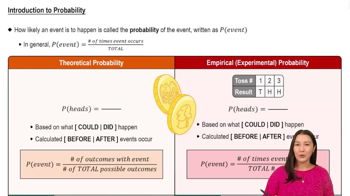
Probability is a measure of the likelihood that an event will occur, expressed as a number between 0 and 1. In this context, it involves calculating the chance of selecting a person who is either male or does not wear glasses from the total sample of 3203 individuals. Understanding how to compute probabilities using the total number of favorable outcomes divided by the total number of possible outcomes is essential.
Video consigliato:
Percorso guidato
5:37
Introduction to Probability

Union of Events

The union of events refers to the occurrence of at least one of the events in question. In this scenario, we are interested in the union of two events: being male and not wearing glasses. The probability of the union can be calculated using the formula P(A ∪ B) = P(A) + P(B) - P(A ∩ B), which accounts for any overlap between the two events.
Video consigliato:
Percorso guidato
05:54
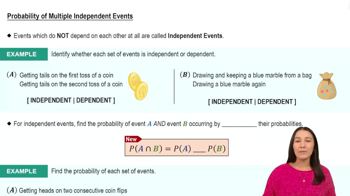
Probability of Multiple Independent Events

Complementary Events

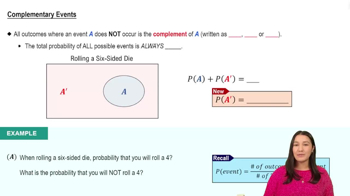
Complementary events are two outcomes of a situation that are mutually exclusive and together cover all possible outcomes. In this case, the event of not wearing glasses can be understood as the complement of wearing glasses. Recognizing complementary events helps in calculating probabilities more efficiently, especially when determining the likelihood of an event not occurring.
Video consigliato:
Percorso guidato
4:23
Complementary Events
Pratica correlata
Domanda del libro di testo

2. Determine whether each number could represent the probability of an event. Explain your reasoning. c. 2.3

183
views

Domanda del libro di testo

50. Investment Committee A company has 200 employees, consisting of 144 women and 56 men. The company wants to select five employees to serve as an investment committee.

d. Explain how the company can select a representative sample of the male and female population of employees.

71
views
Domanda del libro di testo

Using the Multiplication Rule In Exercises 19-32, use the Multiplication Rule.

25. Best President In a sample of 1500 adult U.S. citizens, 270 said that Barack Obama was the best president in U.S. history. Two adult U.S. citizens are selected at random.

(Adapted from YouGov)

d. Which of the events can be considered unusual? Explain.

99
views
Domanda del libro di testo

22. Brexit A survey asked 1115 British adults how Britain's decision to leave the European Union has impacted the country. The results are shown in the Pareto chart. Find the

probability of each event. (Adapted from Ipsos)

d. Randomly selecting a British adult who feels that the move has had a fairly positive or very positive impact on Great Britain

77
views
Domanda del libro di testo

Politics The responses of 1500 U.S. adults to a survey that asked them to state their own political viewpoints are shown in the Pareto chart. Find the probability of each event.(Adapted from YouGov)

d. Randomly selecting a person from the sample who is either unsure or moderate


71
views
Domanda del libro di testo

2. Determine whether each number could represent the probability of an event. Explain your reasoning. d. -0.0004

137
views