
Ch. 3 - Probability
Larson - Elementary Statistics: Picturing the World 8th Edition
Larson8th EditionElementary Statistics: Picturing the WorldISBN: 9780137493470Non è quello che usi tu?Cambia libro di testo
Capitolo 3, Problema 3.1.21

Finding the Probability of an Event In Exercises 21-24, the probability that an event will not happen is given. Find the probability that the event will happen. 
21. P(E') =0.95

Guida verificata passo dopo passo
1
Step 1: Understand the problem. The probability of an event not happening, denoted as P(E'), is given as 0.95. You are tasked with finding the probability of the event happening, denoted as P(E).
Step 2: Recall the relationship between the probability of an event happening and not happening. The sum of these probabilities must equal 1, as they are complementary events. Mathematically, this is expressed as: P(E) + P(E') = 1.
Step 3: Rearrange the formula to solve for P(E). Subtract P(E') from both sides: P(E) = 1 - P(E').
Step 4: Substitute the given value of P(E') into the formula. In this case, P(E') = 0.95, so the equation becomes: P(E) = 1 - 0.95.
Step 5: Perform the subtraction to find the probability of the event happening. This will give you the value of P(E).

Risposta video verificata per un problema simile:

Questa soluzione video è stata consigliata dai nostri tutor come utile per risolvere questo problema.
Durata del video:
1m

Concetti chiave

Ecco i concetti essenziali che devi comprendere per rispondere correttamente alla domanda.

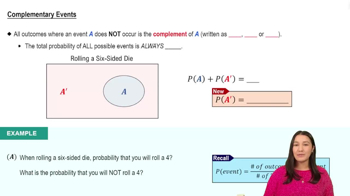
Complementary Events

In probability theory, complementary events are two outcomes of a single event that cannot occur at the same time. If an event E occurs, its complement E' (not E) represents all outcomes where E does not happen. The sum of the probabilities of an event and its complement is always equal to 1, which is a fundamental principle in probability.
Video consigliato:
Percorso guidato
4:23
Complementary Events

Probability Calculation

Probability is a measure of the likelihood that an event will occur, expressed as a number between 0 and 1. To find the probability of an event happening, you can subtract the probability of the event not happening from 1. For example, if P(E') = 0.95, then P(E) = 1 - P(E') = 0.05, indicating a low likelihood of the event occurring.
Video consigliato:
Percorso guidato
07:09
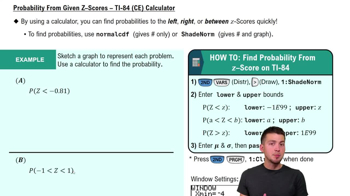
Probability From Given Z-Scores - TI-84 (CE) Calculator

Basic Probability Rules

Basic probability rules include the addition and multiplication rules, which help in calculating the probabilities of combined events. The addition rule states that the probability of either of two mutually exclusive events occurring is the sum of their individual probabilities. Understanding these rules is essential for solving more complex probability problems and for interpreting results correctly.
Video consigliato:
Percorso guidato
5:37
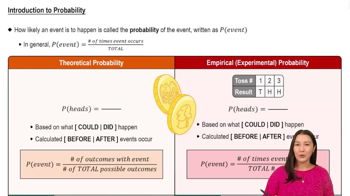
Introduction to Probability
Pratica correlata
Domanda del libro di testo

Classifying Types of Probability In Exercises 53-58, classify the statement as an example of classical probability, empirical probability, or subjective probability. Explain your reasoning.

55. An analyst feels that the probability of a team winning an upcoming game is 60%.

114
views
Domanda del libro di testo

Finding the Probability of the Complement of an Event The age distribution of the residents of Ithaca, New York, is shown at the left. In Exercises 59-62, find the probability of the event. (Source: U.S. Census Bureau)

61. Event C: A randomly chosen resident of Ithaca is not less than 18 years old.

128
views
Domanda del libro di testo

Finding the Probability of the Complement of an Event In Exercises 17-20, the probability that an event will happen is given. Find the probability that the event will not happen.

19. P(E)=0.03

287
views
Domanda del libro di testo

"Classifying Events as Independent or Dependent In Exercises 9-14, determine whether the events are independent or dependent. Explain your reasoning.

9. Selecting a king from a standard deck of 52 playing cards, replacing it, and then selecting a queen from the deck"

66
views
Domanda del libro di testo

Writing In Exercises 89 and 90, write a statement that represents the complement of the probability.

90. The probability of randomly choosing a car with more than one cause for showing its "CHECK ENGINE" light from the population of vehicles showing "CHECK ENGINE" lights.

103
views
Domanda del libro di testo

Classifying Events as Independent or Dependent In Exercises 9-14, determine whether the events are independent or dependent. Explain your reasoning.

14. A ball is selected from a bin of balls numbered from 1 through 52. It is replaced, and then a second numbered ball is selected from the bin.

86
views