Ch. 3 - Probability
Larson - Elementary Statistics: Picturing the World 8th Edition
Larson8th EditionElementary Statistics: Picturing the WorldISBN: 9780137493470Non è quello che usi tu?Cambia libro di testo
Capitolo 3, Problema 3.RE.44

In Exercises 41-44, perform the indicated calculation.
44. (5C3)/(10C3)

Guida verificata passo dopo passo
1
Step 1: Understand the problem. The problem involves calculating a ratio of combinations. Specifically, you need to compute \( \frac{{5C3}}{{10C3}} \), where \( nCk \) represents the number of ways to choose \( k \) items from \( n \) items without regard to order.
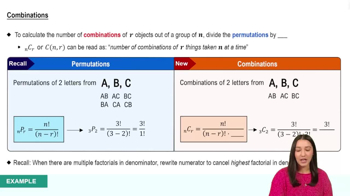
Step 2: Recall the formula for combinations. The formula for \( nCk \) is \( \binom{n}{k} = \frac{{n!}}{{k!(n-k)!}} \), where \( n! \) is the factorial of \( n \).
Step 3: Compute \( 5C3 \) using the formula. Substitute \( n = 5 \) and \( k = 3 \) into the formula: \( \binom{5}{3} = \frac{{5!}}{{3!(5-3)!}} = \frac{{5!}}{{3! \cdot 2!}} \). Simplify this expression.
Step 4: Compute \( 10C3 \) using the formula. Substitute \( n = 10 \) and \( k = 3 \) into the formula: \( \binom{10}{3} = \frac{{10!}}{{3!(10-3)!}} = \frac{{10!}}{{3! \cdot 7!}} \). Simplify this expression.
Step 5: Divide the results of \( 5C3 \) and \( 10C3 \). Use the simplified values from Steps 3 and 4 to compute \( \frac{{5C3}}{{10C3}} \). Simplify the fraction to get the final result.

Risposta video verificata per un problema simile:

Questa soluzione video è stata consigliata dai nostri tutor come utile per risolvere questo problema.
Durata del video:
2m

Concetti chiave

Ecco i concetti essenziali che devi comprendere per rispondere correttamente alla domanda.

Combinations

Combinations refer to the selection of items from a larger set where the order does not matter. The notation 'nCr' represents the number of ways to choose 'r' items from 'n' items, calculated using the formula n! / (r!(n-r)!), where '!' denotes factorial. Understanding combinations is essential for solving problems involving group selections.
Video consigliato:

Factorial

A factorial, denoted as 'n!', is the product of all positive integers up to 'n'. For example, 5! = 5 × 4 × 3 × 2 × 1 = 120. Factorials are fundamental in combinatorial calculations, as they help determine the total arrangements or selections of items in various scenarios.
Video consigliato:

Probability

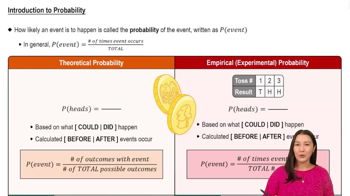
Probability is a measure of the likelihood of an event occurring, expressed as a ratio of favorable outcomes to the total number of possible outcomes. In the context of combinations, the ratio of two combinations, such as (5C3)/(10C3), can represent the probability of selecting a specific group from a larger set, providing insights into comparative likelihoods.
Video consigliato:
Percorso guidato
5:37
Introduction to Probability
Pratica correlata
Domanda del libro di testo

"In Exercises 19-22, determine whether the events are independent or dependent. Explain your reasoning.

21. Taking a driver's education course and passing the driver's license exam"

65
views

Domanda del libro di testo

In Exercises 1-4, identify the sample space of the probability experiment and determine the number of outcomes in the event. Draw a tree diagram when appropriate.

3. Experiment: Choosing a month of the year

Event: Choosing a month that begins with the letter J

115
views
Domanda del libro di testo

In Exercises 25 and 26, determine whether the events are mutually exclusive. Explain your reasoning.

25. Event A: Randomly select a red jelly bean from a jar.

Event B: Randomly select a yellow jelly bean from the jar.

116
views
Domanda del libro di testo

In Exercises 41-44, perform the indicated calculation.

42. 8P6

125
views
Domanda del libro di testo

Telephone Numbers The telephone numbers for a region of Pennsylvania have an area code of 570. The next seven digits represent the local telephone numbers for that region. These cannot begin with a 0 or 1. In Exercises 15 and 16, assume your cousin lives within the given area code.

16. What is the probability of not randomly generating your cousin's telephone number on the first try?

88
views
Domanda del libro di testo

In Exercises 19-22, determine whether the events are independent or dependent. Explain your reasoning.

19. Tossing a coin four times and getting four heads, and then tossing it a fifth time and getting a head

144
views