Ch. 3 - Probability
Larson - Elementary Statistics: Picturing the World 8th Edition
Larson8th EditionElementary Statistics: Picturing the WorldISBN: 9780137493470Non è quello che usi tu?Cambia libro di testo
Capitolo 3, Problema 3.2.29a

Using the Multiplication Rule In Exercises 19-32, use the Multiplication Rule.
29. In Vitro Fertilization In a recent year, about 1.9% of all infants born in the U.S. were conceived through assisted reproductive technology (ART). Of the ART deliveries, about 26.4% resulted in multiple births. (Source: Morbidity and Mortality Weekly Report)
a. Find the probability that a randomly selected infant was conceived through ART and was part of a multiple birth.

Guida verificata passo dopo passo
1
Understand the problem: We are tasked with finding the probability that a randomly selected infant was conceived through ART and was part of a multiple birth. This involves using the Multiplication Rule for probabilities.
Recall the Multiplication Rule: The probability of two events A and B both occurring is given by P(A and B) = P(A) × P(B|A), where P(B|A) is the probability of event B occurring given that event A has occurred.
Identify the events: Let event A be 'an infant was conceived through ART' and event B be 'an infant was part of a multiple birth given that they were conceived through ART.' From the problem, P(A) = 0.019 (1.9%) and P(B|A) = 0.264 (26.4%).
Apply the Multiplication Rule: Substitute the given probabilities into the formula P(A and B) = P(A) × P(B|A). This becomes P(A and B) = 0.019 × 0.264.
Interpret the result: The product of these probabilities will give the probability that a randomly selected infant was conceived through ART and was part of a multiple birth. Perform the multiplication to find the final probability.

Risposta video verificata per un problema simile:

Questa soluzione video è stata consigliata dai nostri tutor come utile per risolvere questo problema.
Durata del video:
3m

Concetti chiave

Ecco i concetti essenziali che devi comprendere per rispondere correttamente alla domanda.

Multiplication Rule

The Multiplication Rule in probability states that the probability of two independent events occurring together is the product of their individual probabilities. In this context, it helps calculate the likelihood of an infant being conceived through assisted reproductive technology (ART) and also being part of a multiple birth. This rule is essential for combining probabilities in scenarios where events are dependent or independent.
Video consigliato:
Percorso guidato
05:54
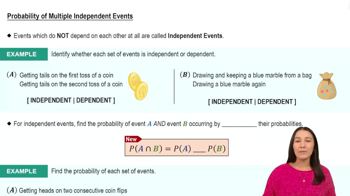
Probability of Multiple Independent Events

Conditional Probability

Conditional probability refers to the probability of an event occurring given that another event has already occurred. In this question, understanding the probability of multiple births given that an infant was conceived through ART is crucial. This concept allows us to refine our calculations by focusing on the specific conditions of the events involved.
Video consigliato:
Percorso guidato
5:37
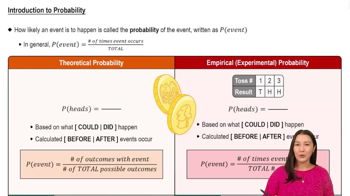
Introduction to Probability

Joint Probability

Joint probability is the probability of two events happening at the same time. In this case, it involves finding the probability that an infant is both conceived through ART and is part of a multiple birth. This concept is key to solving the problem, as it combines the probabilities of the two related events into a single measure.
Video consigliato:
Percorso guidato
5:37
Introduction to Probability
Pratica correlata
Domanda del libro di testo

18. Rolling a Die You roll a die. Find the probability of each event.

b. Rolling a 2 or an odd number

101
views

Domanda del libro di testo

"Using the Multiplication Rule In Exercises 19-32, use the Multiplication Rule.

28. Blood Types The probability that a Latinx American person in the United States has type A+ blood is 29%. Four Latinx American people in the United States are selected at random. (Source: American National Red Cross)

a. Find the probability that all four have type A+ blood."

85
views
Domanda del libro di testo

Shuffle Play You use a shuffle playback feature to randomly play songs in a playlist. The playlist of 56 songs includes 15 instrumental songs.

a. What is the probability that the first three songs to play are instrumental songs? (Assume a song cannot be repeated.)

95
views
Domanda del libro di testo

Using the Multiplication Rule In Exercises 19-32, use the Multiplication Rule.

24. Knowing a Person Who Was Murdered In a sample of 11,771 children ages 2 to 17, 8% have lost a friend or relative to murder. Four children are selected at random. (Adapted from University of New Hampshire)

a. Find the probability that all four have lost a friend or relative to murder.

113
views
Domanda del libro di testo

"Using the Multiplication Rule In Exercises 19-32, use the Multiplication Rule.

26. Worst President In a sample of 1500 adult U.S. citizens, 690 said that Donald Trump was the worst president in U.S. history. Three adult U.S. citizens are selected at random.

(Adapted from YouGov)

b. Find the probability that none of the three adult U.S. citizens say that Donald Trump was the worst president in U.S. history."

40
views
Domanda del libro di testo

Finding Conditional Probabilities In Exercises 7 and 8, use the table to find each conditional probability.

7. Business Degrees The table shows the numbers of male and female students in the United States who received bachelor's degrees in business and nonbusiness fields in a recent year. (Source: National Center for Educational Statistics)

b. Find the probability that a randomly selected bachelor's degree-earning student received a business degree, given that the student is female.

107
views