
Ch. 4 - Discrete Probability Distributions
Larson - Elementary Statistics: Picturing the World 8th Edition
Larson8th EditionElementary Statistics: Picturing the WorldISBN: 9780137493470Non è quello che usi tu?Cambia libro di testo
Capitolo 4, Problema 4.1.27

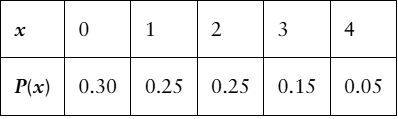
Identifying Probability Distributions In Exercises 27 and 28, determine whether the distribution is a probability distribution. If it is not a probability distribution, explain why.

Guida verificata passo dopo passo
1
Step 1: Understand the requirements for a probability distribution. A probability distribution must satisfy two conditions: (1) The sum of all probabilities must equal 1, and (2) each individual probability must be between 0 and 1 inclusive.
Step 2: Verify the first condition by summing all the probabilities in the table. Add P(0), P(1), P(2), P(3), and P(4). Use the formula: \( \sum P(x) = P(0) + P(1) + P(2) + P(3) + P(4) \).
Step 3: Check the second condition by ensuring that each probability value in the table (0.30, 0.25, 0.25, 0.15, 0.05) is between 0 and 1 inclusive. If any value is outside this range, the distribution is not valid.
Step 4: If both conditions are satisfied, conclude that the given distribution is a probability distribution. If either condition fails, explain why the distribution is not valid.
Step 5: Interpret the results and provide reasoning based on the checks performed in steps 2 and 3. For example, if the sum of probabilities is not equal to 1, state the discrepancy and its impact on validity.

Risposta video verificata per un problema simile:

Questa soluzione video è stata consigliata dai nostri tutor come utile per risolvere questo problema.
Durata del video:
2m

Concetti chiave

Ecco i concetti essenziali che devi comprendere per rispondere correttamente alla domanda.

Probability Distribution

A probability distribution describes how probabilities are assigned to each possible value of a random variable. For a distribution to be valid, the probabilities must be non-negative and sum to one. This concept is fundamental in statistics as it provides a framework for understanding the likelihood of different outcomes.
Video consigliato:
Percorso guidato
06:39
Calculating Probabilities in a Binomial Distribution

Sum of Probabilities

In a valid probability distribution, the sum of all probabilities must equal 1. This ensures that the total likelihood of all possible outcomes is accounted for. If the sum is less than or greater than 1, the distribution cannot be considered valid, indicating an error in the assignment of probabilities.
Video consigliato:
Percorso guidato
5:37
Introduction to Probability

Non-negativity of Probabilities

Probabilities must be non-negative, meaning they cannot be less than zero. This principle is essential because negative probabilities do not have a meaningful interpretation in the context of likelihood. Each probability value in a distribution must reflect a real chance of occurrence, reinforcing the need for non-negativity.
Video consigliato:
Percorso guidato
5:14
Probability of Non-Mutually Exclusive Events
Pratica correlata
Domanda del libro di testo

Constructing and Graphing Discrete Probability Distributions In Exercises 19 and 20, (a) construct a probability distribution, and (b) graph the probability distribution using a histogram and describe its shape.


Televisions The number of high-definition (HD) televisions per household in a small town

131
views
Domanda del libro di testo

In your own words, describe the difference between the value of x in a binomial distribution and in the Poisson distribution.

144
views
Domanda del libro di testo

Determining a Missing Probability In Exercises 25 and 26, determine the missing probability for the probability distribution.

162
views
Domanda del libro di testo

Graphical Analysis In Exercises 3–5, the histogram represents a binomial distribution with five trials. Match the histogram with the appropriate probability of success p. Explain your reasoning.

a. p = 0.25

b. p = 0.50

c. p = 0.75


81
views
Domanda del libro di testo

Finding an Expected Value In Exercises 37 and 38, find the expected value E(x) to the player for one play of the game. If x is the gain to a player in a game of chance, then E(x) is usually negative. This value gives the average amount per game the player can expect to lose.


In American roulette, the wheel has the 38 numbers, 00, 0, 1, 2, . . ., 34, 35, and 36, marked on equally spaced slots. If a player bets \$1 on a number and wins, then the player keeps the dollar and receives an additional \$35. Otherwise, the dollar is lost.

113
views
Domanda del libro di testo

"Using a Distribution to Find Probabilities In Exercises 11–26, find the indicated probabilities using the geometric distribution, the Poisson distribution, or the binomial distribution. Then determine whether the events are unusual. If convenient, use a table or technology to find the probabilities.


Hurricanes The mean number of hurricanes to strike the U.S. mainland per year from 1851 through 2020 was about 1.8. Find the probability that the number of hurricanes striking the U.S. mainland in any given year from 1851 through 2020 is (a) exactly one, (b) at most one, and (c) more than one. (Source: National Oceanic & Atmospheric Administration)"

84
views