Ch. 4 - Discrete Probability Distributions
Larson - Elementary Statistics: Picturing the World 8th Edition
Larson8th EditionElementary Statistics: Picturing the WorldISBN: 9780137493470Non è quello che usi tu?Cambia libro di testo
Capitolo 4, Problema 4.T.1c

In Exercises 1–3, find the indicated probabilities using the geometric distribution, the Poisson distribution, or the binomial distribution. Then determine whether the events are unusual. If convenient, use a table or technology to find the probabilities.
One out of every 42 tax returns for incomes over \$1 million requires an audit. An auditor is examining tax returns for over \$1 million. Find the probability that (c) none of the first five returns the tax auditor examines require an audit.

Guida verificata passo dopo passo
1
Step 1: Identify the type of probability distribution to use. Since the problem involves repeated independent trials with a fixed probability of success (a tax return requiring an audit), the binomial distribution is appropriate. The binomial distribution is defined as P(X = k) = (n choose k) * p^k * (1-p)^(n-k), where n is the number of trials, k is the number of successes, and p is the probability of success.
Step 2: Define the parameters of the binomial distribution. Here, n = 5 (the number of tax returns examined), k = 0 (we are looking for the probability of no audits), and p = 1/42 (the probability of a single tax return requiring an audit).
Step 3: Substitute the values into the binomial probability formula. Using MathML, the formula becomes: P(X=0)=(n!/(k!(n-k)!))*p^k*(1-p)^(n-k). For this problem, substitute n = 5, k = 0, and p = 1/42.
Step 4: Simplify the formula. Since k = 0, the term p^k becomes 1, and the binomial coefficient simplifies to 1. The formula reduces to P(X = 0) = (1-p)^n. Substitute p = 1/42 and n = 5 into the formula: P(X=0)=(1-1/42)^5.
Step 5: Determine whether the event is unusual. An event is typically considered unusual if its probability is less than 0.05. Calculate the probability from Step 4 and compare it to 0.05 to determine if the event is unusual.

Risposta video verificata per un problema simile:

Questa soluzione video è stata consigliata dai nostri tutor come utile per risolvere questo problema.
Durata del video:
2m

Concetti chiave

Ecco i concetti essenziali che devi comprendere per rispondere correttamente alla domanda.

Geometric Distribution

The geometric distribution models the number of trials needed to achieve the first success in a series of independent Bernoulli trials. In this context, it can be used to find the probability of observing a certain number of failures before the first success occurs. The probability of success is constant across trials, making it suitable for scenarios like auditing tax returns.
Video consigliato:
Percorso guidato
06:38
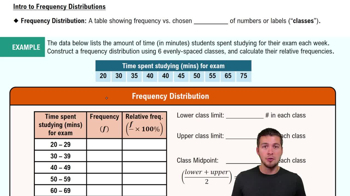
Intro to Frequency Distributions

Binomial Distribution

The binomial distribution describes the number of successes in a fixed number of independent Bernoulli trials, each with the same probability of success. In this case, it can be applied to determine the probability of none of the five tax returns requiring an audit, where each return has a success probability of 1/42. The binomial formula is useful for calculating probabilities in scenarios with a defined number of trials.
Video consigliato:
Percorso guidato
03:28
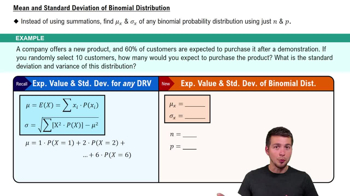
Mean & Standard Deviation of Binomial Distribution

Unusual Events

An event is considered unusual if its probability is low, typically defined as less than 5%. In the context of this problem, after calculating the probability of none of the five tax returns requiring an audit, one must assess whether this probability falls below the threshold for being classified as unusual. This helps in understanding the significance of the results in practical terms.
Video consigliato:
Percorso guidato
05:54
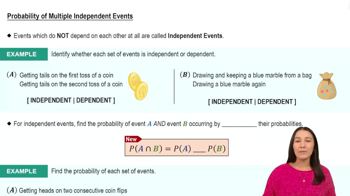
Probability of Multiple Independent Events
Pratica correlata
Domanda del libro di testo

In Exercises 1–7, consider a grocery store that can process a total of four customers at its checkout counters each minute.

The mean number of arrivals per minute is four. Find the probability that

b. more than four customers will arrive during the first minute.

87
views
Domanda del libro di testo

In Exercises 1–3, find the indicated probabilities using the geometric distribution, the Poisson distribution, or the binomial distribution. Then determine whether the events are unusual. If convenient, use a table or technology to find the probabilities.

One out of every 42 tax returns for incomes over \$1 million requires an audit. An auditor is examining tax returns for over \$1 million. Find the probability that (a) the first return requiring an audit is the 25th return the tax auditor examines, (b) the first return requiring an audit is the first or second return the tax auditor examines, and (c) none of the first five returns the tax auditor examines require an audit. (Source: Kiplinger)

93
views
Domanda del libro di testo

In Exercises 1–7, consider a grocery store that can process a total of four customers at its checkout counters each minute.

The mean number of arrivals per minute is four. Find the probability that

a. three, four, or five customers will arrive during the third minute.

93
views
Domanda del libro di testo

The table shows the ages of students in a freshman orientation course.

b. Graph the probability distribution using a histogram and describe its shape.

115
views
Domanda del libro di testo

In Exercises 1–7, consider a grocery store that can process a total of four customers at its checkout counters each minute.

The mean number of arrivals per minute is four. Find the probability that

c. more than four customers will arrive during each of the first four minutes.

79
views
Domanda del libro di testo

The table shows the ages of students in a freshman orientation course.

a. Construct a probability distribution.

118
views