
Ch. 4 - Discrete Probability Distributions
Larson - Elementary Statistics: Picturing the World 8th Edition
Larson8th EditionElementary Statistics: Picturing the WorldISBN: 9780137493470Non è quello che usi tu?Cambia libro di testo
Capitolo 4, Problema 4.Q.4a

The five-year survival rate of people who undergo a liver transplant is 75%. The surgery is performed on six patients. (Source: Mayo Clinic)
a. Construct a binomial distribution.

Guida verificata passo dopo passo
1
Step 1: Understand the problem. This is a binomial distribution problem where we are analyzing the survival rate of patients undergoing liver transplants. The probability of success (survival) is given as 75% or 0.75, and the number of trials (patients) is 6.
Step 2: Recall the formula for the binomial probability distribution. The probability of exactly k successes in n trials is given by: P(k)=(n!k!(n-k)!)×pk×(1-p)n-k, where n is the number of trials, k is the number of successes, and p is the probability of success.
Step 3: Identify the values for this problem. Here, n = 6 (number of patients), p = 0.75 (probability of survival), and k will range from 0 to 6 (number of survivors). You will calculate the probability for each value of k using the formula.
Step 4: Compute the binomial coefficients for each value of k. The binomial coefficient is calculated as (n!)/(k!×(n-k)!). For example, for k = 0, 1, 2, ..., 6, calculate the respective coefficients.
Step 5: Plug the values of k, n, and p into the binomial probability formula for each k (from 0 to 6). This will give you the probabilities for each possible number of survivors. Once calculated, organize these probabilities into a table to construct the binomial distribution.

Risposta video verificata per un problema simile:

Questa soluzione video è stata consigliata dai nostri tutor come utile per risolvere questo problema.
Durata del video:
4m

Concetti chiave

Ecco i concetti essenziali che devi comprendere per rispondere correttamente alla domanda.

Binomial Distribution

A binomial distribution models the number of successes in a fixed number of independent Bernoulli trials, each with the same probability of success. In this context, the success is defined as a patient surviving five years post-liver transplant, with a probability of 0.75. The distribution is characterized by two parameters: the number of trials (n) and the probability of success (p).
Video consigliato:
Percorso guidato
03:28
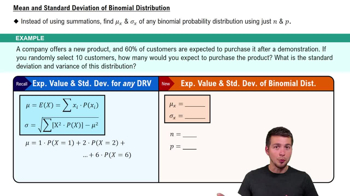
Mean & Standard Deviation of Binomial Distribution

Parameters of Binomial Distribution

The parameters of a binomial distribution are 'n', the number of trials, and 'p', the probability of success on each trial. For this question, 'n' is 6 (the number of patients) and 'p' is 0.75 (the survival rate). These parameters are essential for calculating probabilities related to the number of patients who survive the five-year mark.
Video consigliato:
Percorso guidato
03:28
Mean & Standard Deviation of Binomial Distribution

Calculating Probabilities

To construct a binomial distribution, one must calculate the probabilities of different outcomes using the binomial probability formula: P(X=k) = (n choose k) * p^k * (1-p)^(n-k). Here, 'k' represents the number of successes (patients surviving), and 'n choose k' is the binomial coefficient. This allows us to determine the likelihood of various survival scenarios among the six patients.
Video consigliato:
Percorso guidato
07:09
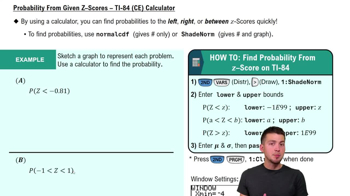
Probability From Given Z-Scores - TI-84 (CE) Calculator
Pratica correlata
Domanda del libro di testo

In Exercises 21–26, find the indicated probabilities using the geometric distribution, the Poisson distribution, or the binomial distribution. Then determine whether the events are unusual. If convenient, use a table or technology to find the probabilities

Thirty-six percent of Americans think there is still a need for the practice of changing their clocks for Daylight Savings Time. You randomly select seven Americans. Find the probability that the number who say there is still a need for changing their clocks for Daylight Savings Time is (c) at least six.

92
views
Domanda del libro di testo

In the past year, thirty-three percent of U.S. adults have put off medical treatment because of the cost. You randomly select nine U.S. adults. Find the probability that the number who have put off medical treatment because of the cost in the past year is (a) exactly three, (b) at most four, and (c) more than five. (Source: Gallup)

89
views
Domanda del libro di testo

In Exercises 21–26, find the indicated probabilities using the geometric distribution, the Poisson distribution, or the binomial distribution. Then determine whether the events are unusual. If convenient, use a table or technology to find the probabilities.

Fourteen percent of noninstitutionalized U.S. adults smoke cigarettes. After randomly selecting ten noninstitutionalized U.S. adults, you ask them whether they smoke cigarettes. Find the probability that the first adult who smokes cigarettes is (c) not one of the first six persons selected.

77
views
Domanda del libro di testo

The table lists the number of wireless devices per household in a small town in the United States.

c. Find the mean, variance, and standard deviation of the probability distribution and interpret the results.

88
views
Domanda del libro di testo

The table lists the number of wireless devices per household in a small town in the United States.

a. Construct a probability distribution.

96
views
Domanda del libro di testo

In Exercises 1 and 2, determine whether the random variable x is discrete or continuous. Explain.


Let x represent the grade on an exam worth a total of 100 points.

98
views