Ch. 5 - Normal Probability Distributions
Larson - Elementary Statistics: Picturing the World 8th Edition
Larson8th EditionElementary Statistics: Picturing the WorldISBN: 9780137493470Non è quello che usi tu?Cambia libro di testo
Capitolo 5, Problema 5.4.17

Finding Probabilities In Exercises 15–18, the population mean and standard deviation are given. Find the indicated probability and determine whether the given sample mean would be considered unusual.


For a random sample of n=45, find the probability of a sample mean being greater than 551 when mu=550 and sigma=3.7.

Guida verificata passo dopo passo
1
Step 1: Identify the given values in the problem. The population mean (μ) is 550, the population standard deviation (σ) is 3.7, the sample size (n) is 45, and we are tasked with finding the probability of the sample mean (x̄) being greater than 551.
Step 2: Calculate the standard error of the mean (SE). The formula for the standard error is: SE=σn. Substitute the values: SE=3.745.
Step 3: Compute the z-score for the sample mean. The formula for the z-score is: z=x̄-μSE. Substitute the values: z=551-550SE.
Step 4: Use the z-score to find the probability. Look up the z-score in the standard normal distribution table or use statistical software to find the cumulative probability. Since the problem asks for the probability of the sample mean being greater than 551, calculate 1-P(Z<z).
Step 5: Determine if the sample mean is unusual. A sample mean is considered unusual if the probability is less than 0.05 (5%). Compare the calculated probability to this threshold to make the determination.

Risposta video verificata per un problema simile:

Questa soluzione video è stata consigliata dai nostri tutor come utile per risolvere questo problema.
Durata del video:
4m

Concetti chiave

Ecco i concetti essenziali che devi comprendere per rispondere correttamente alla domanda.

Central Limit Theorem

The Central Limit Theorem states that the distribution of sample means will approach a normal distribution as the sample size increases, regardless of the population's distribution, provided the sample size is sufficiently large (typically n > 30). This theorem is crucial for calculating probabilities related to sample means.
Video consigliato:
Percorso guidato
04:52
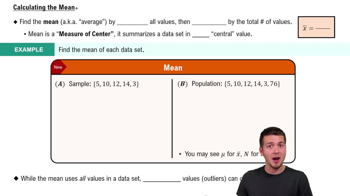
Calculating the Mean

Standard Error

Standard Error (SE) measures the dispersion of sample means around the population mean. It is calculated as the population standard deviation divided by the square root of the sample size (SE = sigma / √n). In this case, it helps determine how much variability to expect in the sample mean.
Video consigliato:
Percorso guidato
08:45
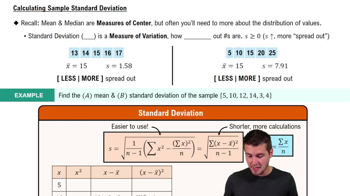
Calculating Standard Deviation

Z-Score

A Z-score indicates how many standard deviations an element is from the mean. It is calculated using the formula Z = (X - mu) / SE, where X is the sample mean. This score is essential for finding probabilities in a standard normal distribution and determining if a sample mean is unusual.
Video consigliato:
Percorso guidato
06:31
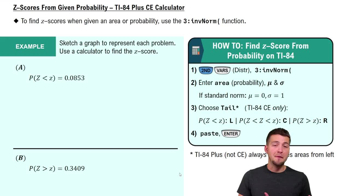
Z-Scores From Given Probability - TI-84 (CE) Calculator