Ch. 6 - Confidence Intervals
Larson - Elementary Statistics: Picturing the World 8th Edition
Larson8th EditionElementary Statistics: Picturing the WorldISBN: 9780137493470Non è quello che usi tu?Cambia libro di testo
Capitolo 6, Problema 6.1.30

In Exercises 29–32, determine the minimum sample size n needed to estimate for the values of c, σ, and E.
c = 0.95, σ = 2.5, E = 1.

Guida verificata passo dopo passo
1
Identify the formula for determining the minimum sample size n for estimating a population mean: n = (zc⋅σE)2, where zc is the critical z-value, σ is the population standard deviation, and E is the margin of error.
Determine the critical z-value (zc) for the given confidence level c = 0.95. Use a z-table or statistical software to find the z-value corresponding to a cumulative probability of 0.975 (since the confidence level is two-tailed).
Substitute the given values into the formula: σ = 2.5 (population standard deviation) and E = 1 (margin of error).
Simplify the numerator of the fraction by multiplying the critical z-value (zc) by the population standard deviation (σ). Then divide the result by the margin of error (E).
Square the result from the previous step to calculate the minimum sample size n. If n is not a whole number, always round up to the nearest whole number, as sample size must be an integer.

Risposta video verificata per un problema simile:

Questa soluzione video è stata consigliata dai nostri tutor come utile per risolvere questo problema.
Durata del video:
1m

Concetti chiave

Ecco i concetti essenziali che devi comprendere per rispondere correttamente alla domanda.

Sample Size Determination

Sample size determination is the process of calculating the number of observations or replicates needed in a statistical study to ensure that the results are reliable and valid. It is crucial for achieving a desired level of precision in estimating population parameters, such as means or proportions, while controlling for the margin of error.
Video consigliato:
Percorso guidato
06:14
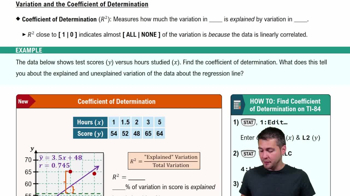
Coefficient of Determination

Confidence Level (c)

The confidence level, denoted as c, represents the probability that the confidence interval will contain the true population parameter. A confidence level of 0.95 indicates that if the same population were sampled multiple times, approximately 95% of the calculated confidence intervals would capture the true parameter, reflecting a high degree of certainty in the estimate.
Video consigliato:
Percorso guidato
06:33
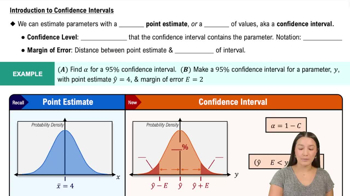
Introduction to Confidence Intervals

Margin of Error (E)

The margin of error, denoted as E, quantifies the range within which the true population parameter is expected to lie, given a certain confidence level. It is a critical component in survey results and statistical estimates, as it indicates the potential deviation from the observed sample statistic, thus influencing the reliability of the conclusions drawn from the data.
Video consigliato:
Percorso guidato
06:33
Introduction to Confidence Intervals