Ch. 6 - Confidence Intervals
Larson - Elementary Statistics: Picturing the World 8th Edition
Larson8th EditionElementary Statistics: Picturing the WorldISBN: 9780137493470Non è quello che usi tu?Cambia libro di testo
Capitolo 6, Problema 6.3.31

Translating Statements In Exercises 29–34, translate the statement into a confidence interval. Approximate the level of confidence.
In a survey of 1000 U.S. adults, 71% think teaching is one of the most important jobs in our country today. The survey’s margin of error is ±3%. (Source: Rasmussen Reports)

Guida verificata passo dopo passo
1
Identify the sample proportion (p̂) from the problem. Here, 71% of the surveyed adults think teaching is one of the most important jobs. Convert this percentage to a decimal: p̂ = 0.71.
Determine the margin of error (ME) provided in the problem. The margin of error is ±3%, which can be written as ME = 0.03 in decimal form.
Construct the confidence interval using the formula: Confidence Interval = p̂ ± ME. This means the lower bound of the interval is p̂ - ME, and the upper bound is p̂ + ME.
Substitute the values into the formula. The lower bound is 0.71 - 0.03, and the upper bound is 0.71 + 0.03. This gives the range of the confidence interval.
Approximate the level of confidence. The margin of error is typically associated with a 95% confidence level unless otherwise stated. Therefore, the confidence level for this interval is approximately 95%.

Risposta video verificata per un problema simile:

Questa soluzione video è stata consigliata dai nostri tutor come utile per risolvere questo problema.
Durata del video:
4m

Concetti chiave

Ecco i concetti essenziali che devi comprendere per rispondere correttamente alla domanda.

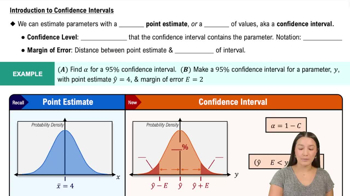
Confidence Interval

A confidence interval is a range of values, derived from sample statistics, that is likely to contain the true population parameter. It is expressed as an interval estimate, typically calculated as the sample proportion plus or minus the margin of error. For example, if 71% of respondents support a statement and the margin of error is ±3%, the confidence interval would be 68% to 74%.
Video consigliato:
Percorso guidato
06:33
Introduction to Confidence Intervals

Margin of Error

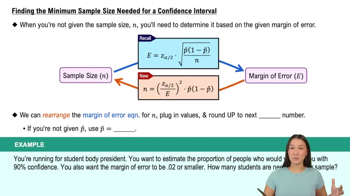
The margin of error quantifies the uncertainty associated with a sample estimate. It indicates the range within which the true population parameter is expected to fall, based on the sample data. In this case, a margin of error of ±3% means that the true percentage of U.S. adults who think teaching is important could be 3% higher or lower than the reported 71%.
Video consigliato:
Percorso guidato
04:08
Finding the Minimum Sample Size Needed for a Confidence Interval

Level of Confidence

The level of confidence reflects the degree of certainty that the true population parameter lies within the confidence interval. Common levels of confidence are 90%, 95%, and 99%. The level of confidence can be approximated based on the sample size and margin of error; for a sample of 1000 with a margin of error of ±3%, a 95% confidence level is often assumed.
Video consigliato:
Percorso guidato
06:33
Introduction to Confidence Intervals