Ch. 7 - Hypothesis Testing with One Sample
Larson - Elementary Statistics: Picturing the World 8th Edition
Larson8th EditionElementary Statistics: Picturing the WorldISBN: 9780137493470Non è quello che usi tu?Cambia libro di testo
Capitolo 7, Problema 7.1.22

Identifying a Test In Exercises 21–24, determine whether the hypothesis test is left-tailed, right-tailed, or two-tailed.


Ha: μ ≥ 5.2
H0: μ < 5.2

Guida verificata passo dopo passo
1
Step 1: Understand the null hypothesis (H0) and the alternative hypothesis (Ha). In this case, H0: μ < 5.2 and Ha: μ ≥ 5.2.
Step 2: Recall that the direction of the test is determined by the alternative hypothesis (Ha). Specifically, the inequality in Ha indicates the type of test.
Step 3: Note that Ha: μ ≥ 5.2 includes the 'greater than or equal to' condition. This suggests that we are testing whether the mean (μ) is greater than or equal to 5.2.
Step 4: Since the focus is on testing whether μ is greater than a specific value (5.2), this is a right-tailed test. A right-tailed test is used when the alternative hypothesis involves a 'greater than' condition.
Step 5: Conclude that the hypothesis test is right-tailed based on the direction of the inequality in the alternative hypothesis (Ha).

Risposta video verificata per un problema simile:

Questa soluzione video è stata consigliata dai nostri tutor come utile per risolvere questo problema.
Durata del video:
1m

Concetti chiave

Ecco i concetti essenziali che devi comprendere per rispondere correttamente alla domanda.

Hypothesis Testing

Hypothesis testing is a statistical method used to make decisions about a population based on sample data. It involves formulating two competing hypotheses: the null hypothesis (H0), which represents a statement of no effect or no difference, and the alternative hypothesis (Ha), which represents what we aim to support. The outcome of the test helps determine whether to reject the null hypothesis in favor of the alternative.
Video consigliato:
Percorso guidato
06:21
Step 1: Write Hypotheses

One-Tailed vs. Two-Tailed Tests

In hypothesis testing, a one-tailed test evaluates the direction of the effect, either testing for an increase or a decrease, while a two-tailed test assesses for any significant difference in either direction. A left-tailed test looks for evidence that the parameter is less than a certain value, whereas a right-tailed test looks for evidence that it is greater. The choice between these tests depends on the research question and the hypotheses formulated.
Video consigliato:
Percorso guidato
09:27
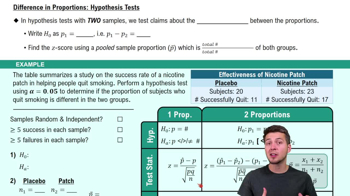
Difference in Proportions: Hypothesis Tests

Interpreting Hypotheses

Interpreting the null and alternative hypotheses is crucial for determining the type of test to conduct. In the given example, the null hypothesis (H0: μ < 5.2) suggests that the mean is less than 5.2, while the alternative hypothesis (Ha: μ ≥ 5.2) indicates that the mean is greater than or equal to 5.2. This setup implies a right-tailed test, as we are interested in whether the mean is significantly greater than 5.2.
Video consigliato:
Percorso guidato
06:21
Step 1: Write Hypotheses